
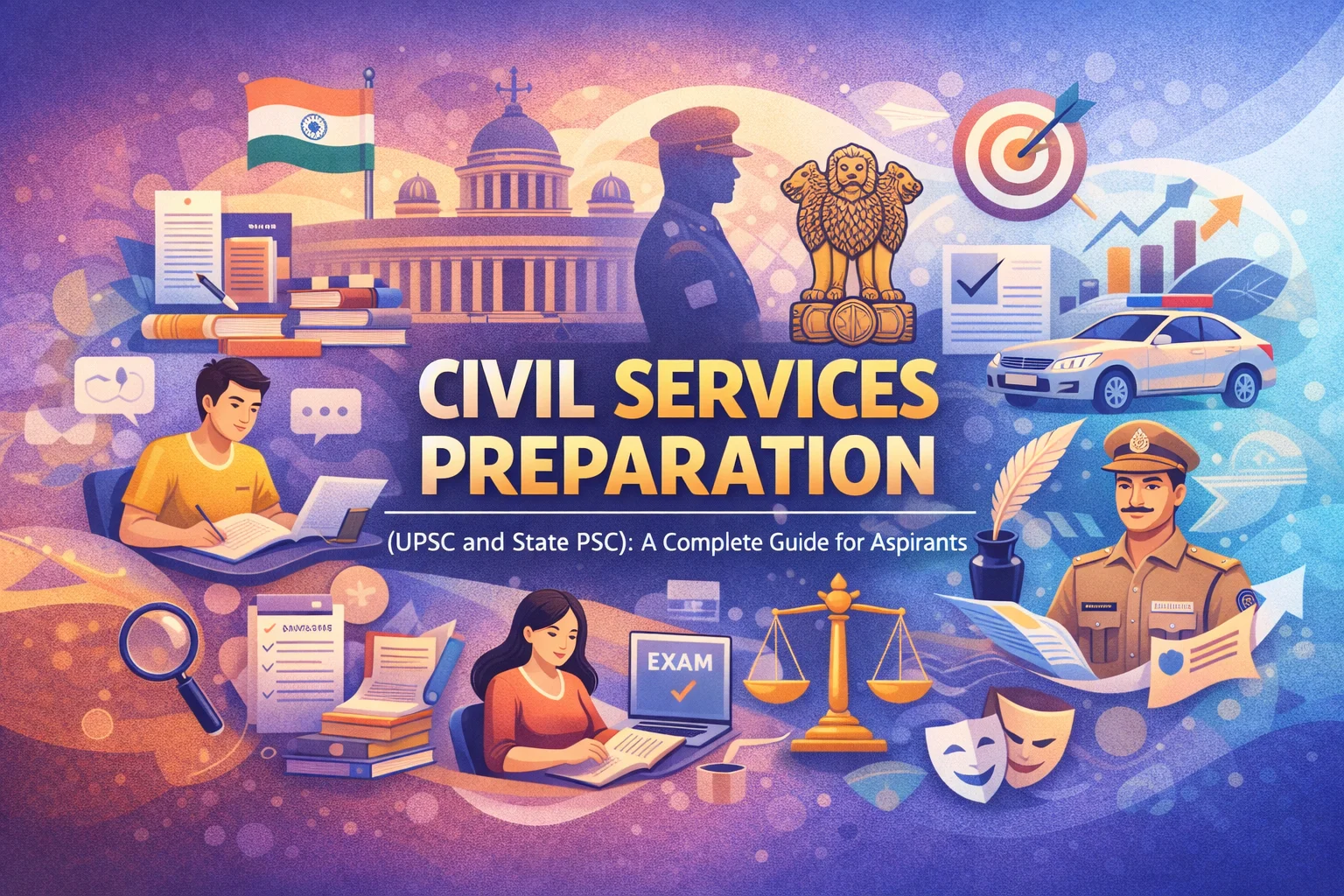
The Civil Services Examination is one of the most prestigious and challenging competitive exams in India. It serves as a gateway to influential administrative roles in both central and state governments. Every year, millions of aspirants prepare for the Union Public Service Commission (UPSC) and State Public Service Commission (State PSC) examinations with the dream of contributing to nation-building and public welfare.
Success in these examinations requires a strategic approach, in-depth knowledge, disciplined preparation, and consistent practice. This comprehensive guide provides detailed insights into the exam pattern, syllabus, preparation strategies, study plans, and essential resources to help aspirants prepare effectively for both UPSC and State PSC examinations.
Table of Contents
Understanding the Civil Services Examination
The Civil Services Examination is conducted to recruit candidates for various administrative and governmental positions. These officers are responsible for policy implementation, governance, law enforcement, and developmental initiatives at the national and state levels.
Top Civil Services in India
| Service | Description |
| Indian Administrative Service (IAS) | Responsible for policy formulation and administration |
| Indian Police Service (IPS) | Ensures law and order and internal security |
| Indian Foreign Service (IFS) | Handles India’s foreign relations and diplomacy |
| Indian Revenue Service (IRS) | Manages taxation and revenue collection |
| State Administrative Services (PCS) | Oversees governance at the state level |
| Deputy Superintendent of Police (DSP) | Maintains law and order within states |
| Tehsildar and Block Development Officer (BDO) | Handles revenue administration and rural development |
These positions offer authority, stability, social respect, and opportunities to contribute meaningfully to society.
UPSC vs State PSC: Key Differences
Understanding the similarities and differences between UPSC and State PSC examinations helps candidates plan their preparation efficiently.
| Feature | UPSC | State PSC |
| Conducting Body | Union Public Service Commission | State Public Service Commission |
| Level | National | State |
| Posts Offered | IAS, IPS, IFS, IRS | SDM, DSP, Tehsildar, BDO |
| Exam Frequency | Once a year | Varies by state |
| Competition Level | Extremely High | Moderate to High |
| Syllabus | National and International Focus | Includes State-Specific Topics |
| Language Options | English and Regional Languages | Includes Regional Languages |
| Jurisdiction | Central Government | State Government |
Approximately 70-80 percent of the syllabus overlaps, making it practical for aspirants to prepare for both examinations simultaneously.
Exam Pattern of UPSC and State PSC
Both UPSC and State PSC follow a three-stage selection process: Preliminary Examination, Main Examination, and Personality Test.
Preliminary Examination (Prelims)
The Preliminary Examination is an objective-type test used for shortlisting candidates for the Mains.
| Paper | Subject | Marks | Nature |
| Paper I | General Studies | 200 | Merit-Based |
| Paper II | CSAT | 200 | Qualifying (Minimum 33%) |
The Prelims assess candidates’ conceptual clarity, analytical ability, and awareness of current affairs.
Main Examination (Mains)
The Mains Examination evaluates a candidate’s intellectual depth, analytical ability, and writing skills through descriptive papers.
| Paper | Subject |
| Paper A | Indian Language (Qualifying) |
| Paper B | English (Qualifying) |
| Essay | Essay Writing |
| GS Paper I | History, Culture, and Geography |
| GS Paper II | Polity, Governance, and International Relations |
| GS Paper III | Economy, Science, Technology, and Environment |
| GS Paper IV | Ethics, Integrity, and Aptitude |
| Paper VI & VII | Optional Subject |
Marks obtained in the Mains and Interview determine the final merit ranking.
Personality Test (Interview)
The final stage assesses the candidate’s personality, communication skills, ethical integrity, leadership qualities, and awareness of socio-economic issues. It evaluates suitability for administrative responsibilities rather than academic knowledge.
UPSC and State PSC Syllabus Overview
A thorough understanding of the syllabus is essential for effective preparation.
Prelims Syllabus
| Subject | Key Areas |
| History | Ancient, Medieval, and Modern India |
| Geography | Physical, Indian, and World Geography |
| Polity | Constitution, Governance, and Political System |
| Economy | Macroeconomics, Budget, and Economic Development |
| Environment | Ecology, Biodiversity, and Climate Change |
| Science and Technology | Innovations and Applications |
| Current Affairs | National and International Events |
| CSAT | Comprehension, Reasoning, and Quantitative Aptitude |
Mains Syllabus
| Paper | Topics Covered |
| GS I | Culture, History, and Geography |
| GS II | Constitution, Governance, and Social Justice |
| GS III | Economy, Agriculture, Environment, and Technology |
| GS IV | Ethics, Integrity, and Aptitude |
| Essay | Analytical and Philosophical Writing |
| Optional | Subject of Choice |
Additional Topics for State PSC
| Category | Topics |
| State History | Cultural and Political Developments |
| State Geography | Natural Resources and Climate |
| State Economy | Budget, Schemes, and Development |
| State Polity | Local Governance and Administration |
| Regional Current Affairs | State-Level Issues and Policies |
| Culture and Traditions | Festivals, Art, and Heritage |
UPSC and UPPSC-PCS Detailed Comparison
Why Prepare for UPSC and State PSC Together?
Preparing for both UPSC and State PSC simultaneously maximizes opportunities and enhances preparation efficiency. Since a significant portion of the syllabus overlaps, candidates can streamline their study plans while improving their chances of securing a government position.
Integrated preparation saves time, optimizes resources, and ensures comprehensive coverage of subjects. Aspirants can focus on national topics for UPSC and supplement their preparation with state-specific content for PSC examinations.
Step-by-Step Strategy for Civil Services Preparation
Understand the Syllabus and Exam Pattern
A clear understanding of the syllabus prevents unnecessary study and ensures focused preparation. Candidates should carefully analyze previous year question papers to identify trends and important topics.
Build a Strong Foundation with NCERT Books
NCERT textbooks from Classes 6 to 12 provide conceptual clarity and serve as the backbone of Civil Services preparation.
Select Standard Reference Books
Limiting resources to trusted and recommended books prevents confusion and improves retention.
Focus on Current Affairs
Reading reputed newspapers such as The Hindu or The Indian Express is essential for staying informed about national and international developments.
Practice Previous Year Questions
Solving past papers helps aspirants understand the exam pattern and improve accuracy and confidence.
Develop Answer Writing Skills
Regular answer writing enhances analytical thinking, presentation skills, and time management, which are crucial for success in the Mains.
Attempt Mock Tests Regularly
Mock tests simulate the exam environment and help identify strengths and weaknesses.
Revise Consistently
Revision ensures long-term retention and strengthens conceptual clarity. Multiple revisions are essential for success.
Prepare for the Interview
Develop a well-rounded personality, stay updated with current events, and practice mock interviews to build confidence.
Best Books for UPSC and State PSC Preparation
| Subject | Recommended Books |
| Polity | Indian Polity by M. Laxmikanth |
| Modern History | Spectrum by Rajiv Ahir |
| Geography | NCERTs and GC Leong |
| Economy | Indian Economy by Ramesh Singh |
| Environment | Shankar IAS Environment |
| Ethics | Lexicon for Ethics |
| Science and Technology | NCERTs and Current Affairs |
| Current Affairs | The Hindu and The Indian Express |
| CSAT | Quantitative Aptitude by Arun Sharma |
One-Year Study Plan for Civil Services Preparation
| Phase | Duration | Focus Area |
| Phase 1 | Months 1-3 | NCERTs and Basic Concepts |
| Phase 2 | Months 4-6 | Standard Books and Notes |
| Phase 3 | Months 7-9 | Answer Writing and Current Affairs |
| Phase 4 | Months 10-12 | Mock Tests and Revision |
Ideal Daily Study Schedule
| Activity | Time Allocation |
| Core Subjects | 4-5 Hours |
| Current Affairs | 1 Hour |
| Revision | 1-2 Hours |
| Answer Writing Practice | 1 Hour |
| Mock Tests and Analysis | 1 Hour |
Essential Skills Required to Crack Civil Services
Success in Civil Services examinations requires more than academic knowledge. Aspirants must cultivate analytical thinking, ethical integrity, effective communication, leadership qualities, and sound decision-making abilities. Time management and consistency play a crucial role in achieving success.
Common Mistakes to Avoid
Many aspirants fail due to avoidable errors. Ignoring the syllabus, relying on excessive study materials, neglecting revision, and skipping mock tests are common pitfalls. Lack of answer-writing practice and inadequate focus on current affairs can significantly hinder performance. Avoiding these mistakes improves the chances of success.
Career Opportunities After Clearing the Civil Services
| Service | Career Role |
| IAS | District Collector, Cabinet Secretary |
| IPS | Superintendent of Police |
| IFS | Diplomat and Ambassador |
| IRS | Tax Commissioner |
| State PCS | SDM, BDO, Tehsildar, DSP |
These roles offer prestige, authority, job security, and the opportunity to contribute to societal development.
Conclusion
Civil Services preparation is a transformative journey that demands dedication, perseverance, and strategic planning. By understanding the syllabus, following a structured study plan, and maintaining consistency, aspirants can successfully crack both UPSC and State PSC examinations.
Preparing for these exams simultaneously enhances career opportunities and maximizes efficiency. With the right resources, disciplined efforts, and unwavering determination, candidates can achieve their dream of serving the nation and making a meaningful impact on society.
Frequently Asked Questions
Can I prepare for UPSC and State PSC together?
Yes, UPSC and State PSC share nearly 70-80 percent of their syllabus. Aspirants can prepare for both simultaneously by focusing on core subjects first and later incorporating state-specific topics to enhance their chances of success.
How many hours should I study daily for Civil Services preparation?
Ideally, aspirants should study for 6-8 hours daily with consistency. A balanced schedule that includes revision, mock tests, and current affairs is more effective than prolonged but unfocused study sessions.
Is coaching necessary to crack UPSC or State PSC?
Coaching is not mandatory to succeed. With disciplined self-study, standard books, online resources, and regular mock tests, aspirants can clear the examination. However, coaching may provide structured guidance and mentorship for beginners.
How long does it take to prepare for UPSC?
Most aspirants require one to two years of dedicated preparation. The duration depends on academic background, study habits, consistency, and the effectiveness of revision and practice strategies.
What is the minimum qualification for Civil Services?
A bachelor’s degree from a recognized university is the minimum eligibility requirement. Candidates from any academic discipline can apply for both UPSC and State PSC examinations.
Which optional subject is best for UPSC?
The best optional subject depends on an aspirant’s interest, academic background, and availability of study materials. Popular choices include Geography, Sociology, Political Science, and Public Administration.
Are NCERT books sufficient for UPSC preparation?
NCERT books are essential for building conceptual clarity but are not sufficient alone. They should be supplemented with standard reference books, current affairs, and regular practice of previous year questions.
Which newspaper is best for Civil Services preparation?
The Hindu and The Indian Express are widely recommended due to their credible coverage of national and international issues, editorials, and policy analyses relevant to UPSC and State PSC examinations.
What is the success rate of the UPSC Civil Services Examination?
The success rate of the UPSC Civil Services Examination is less than one percent, making it highly competitive. However, strategic preparation, dedication, and consistency significantly improve the chances of success.
Is CSAT compulsory for UPSC Prelims?
Yes, CSAT is a qualifying paper in UPSC Prelims. Candidates must secure at least 33 percent marks to qualify, making it essential to practice aptitude, reasoning, and comprehension regularly.