
Built by assessment professionals for career counsellors, schools, and HR teams – Mind Genics psychometric software delivers scientifically validated personality, aptitude, and intelligence reports instantly, so you spend less time scoring and more time counselling
The scientific and accepted approach for assessing a person’s mental capacity is psychometric testing. These assessments are typically intended to gauge an individual’s appropriateness for a position based on their aptitude and personality traits.
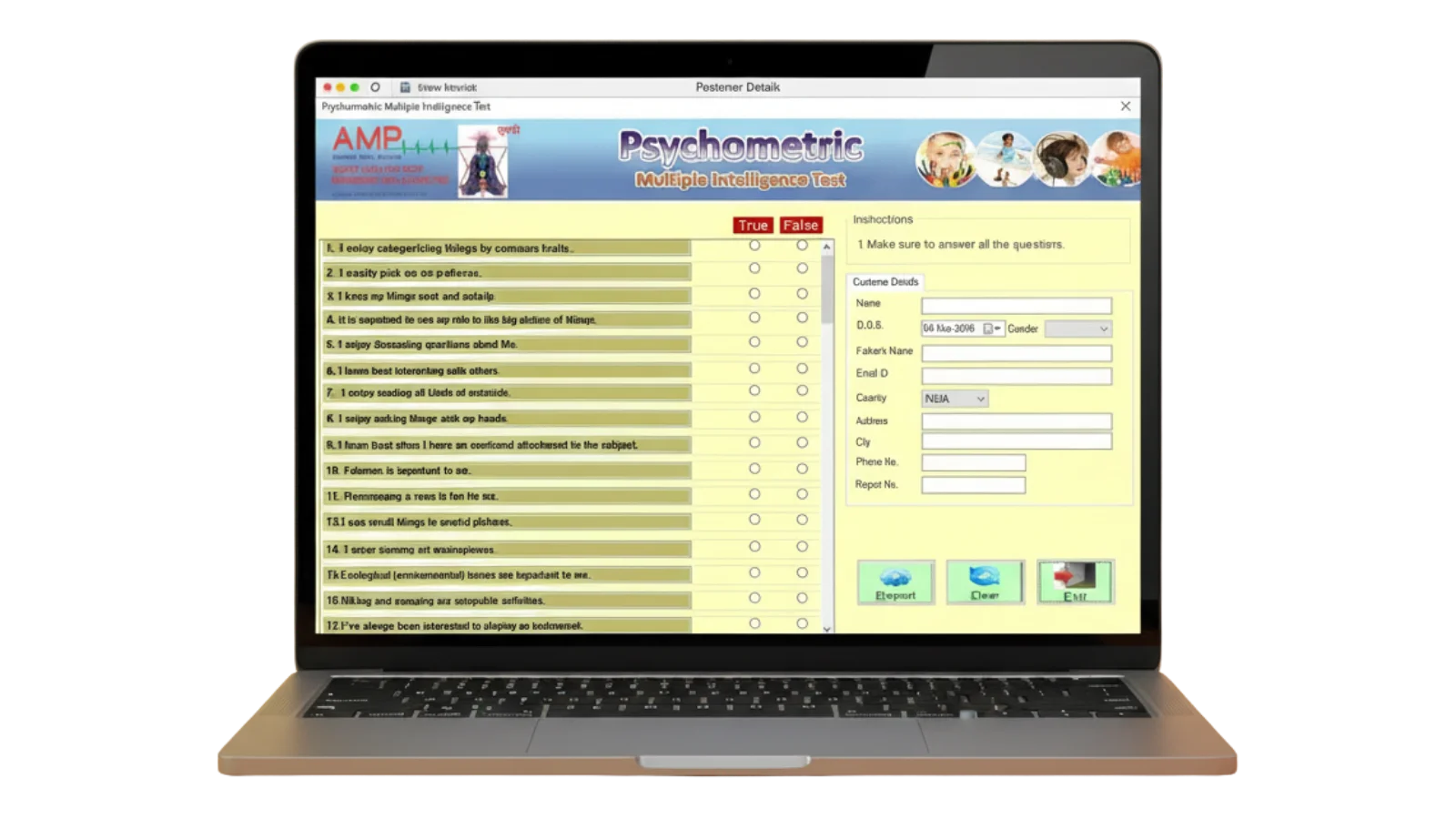
An individual’s personality traits, aptitude, IQ, talents, and behavioral style can all be objectively measured using psychometric testing. In order to match a person’s skills and personality to an appropriate career or role, psychometric tests are frequently used in career counseling and employment.
In career counselling, hiring, and student development, decisions based on instinct alone often lead to poor outcomes. Psychometric assessment software replaces guesswork with structure – using validated psychological instruments to measure what makes each unique.
Unlike a simple personality quiz, a properly designed psychometric test is built on decades of peer-reviewed research. It measures cognitive abilities, behavioural tendencies, emotional intelligence, aptitude, and personality traits using standardised methods that produce consistent, comparable results across thousands of respondents.
Mind Genics brings these validated frameworks into a single digital platform that any career counsellor, school, or HR team can use – without needing a background in psychology or data science. You administer the test, the platform generates a comprehensive psychometric assessment report, and you focus on the counselling conversation that follows.
The result: Faster sessions, more confident recommendations, and clients who feel genuinely understood – not just categorised.
Mind Genics includes four distinct assessment instruments, each grounded in a recognised psychological framework. Together, they give counsellors a 360-degree view of a client’s personality, aptitude, motivations, and career fit – information that would typically require multiple tools and days of processing
Based on Howard Gardner’s theory of Multiple Intelligences, this assessment measures eight distinct intelligence types: linguistic, logical-mathematical, spatial, musical, bodily-kinesthetic, interpersonal, intrapersonal, and naturalist. By understanding how a person learns and processes information, counsellors can recommend not just a career, but a working style and learning environment that suits them.
The report generates a map of the client’s intelligence profile to over 300 career options, giving concrete direction rather than vague suggestions. It is particularly effective for students in classes 8–12 choosing academic streams, and for adults considering a career change.
Best for: Students, career changers, educational stream selection
The PSI is rooted in Carl Jung’s theory of psychological types, which introduced the idea that people consistently prefer certain ways of perceiving the world and making decisions. The PSI is closely aligned with the Myers-Briggs Type Indicator (MBTI) – often described as its structured counterpart – and measures how a person wants to behave, as opposed to how external expectations shape their behaviour.
Where MBTI captures habitual behaviour, PSI captures authentic personality – making it a more honest reflection of who someone truly is. This distinction is especially valuable in career counselling, where helping a client find a role that matches their natural disposition – not just their current habits – leads to longer-term satisfaction.
Best for: Career counselling, team dynamics, personal development coaching
The TAT is a projective psychological assessment tool, originally developed by Henry Murray and Christiana Morgan at Harvard University. Rather than asking direct questions, it presents the respondent with ambiguous images or scenarios and analyses the narratives they construct in response.
This approach reveals unconscious motivations, dominant emotional drives, unresolved conflicts, and deep personal values that a respondent might not consciously articulate – or might deliberately conceal – in a direct questionnaire. In a counselling context, TAT results help practitioners understand why a client makes the choices they do, not just what choices they prefer.
Best for: Deep personal development work, therapy-adjacent counselling, leadership coaching
The RSI is built on Edgar Schein’s Career Anchor Theory, which proposes that every person has a central set of values, motivations, and competencies that they will not abandon even when forced to make difficult career choices. Schein identified eight career anchors: technical/functional competence, general managerial competence, autonomy/independence, security/stability, entrepreneurial creativity, service/dedication, pure challenge, and lifestyle integration.
Understanding a client’s dominant career anchor explains not just what work they want to do, but why they want to do it – and what conditions will make them thrive or disengage over time. This is particularly powerful in corporate HR assessments and mid-career transition counselling.
Best for: Corporate HR, mid-career professionals, leadership development programs
Log in to the Mind Genics platform and assign one or more psychometric tests to your client, student, or candidate. Tests can be completed on any device – smartphone, tablet, or desktop – with no app download required. You control which tests to administer based on the counselling objective: career guidance, personality profiling, hiring, or personal development.
The moment your client completes the assessment, the platform processes their responses and generates a comprehensive psychometric report – covering personality type, intelligence profile, career anchor, motivational drivers, and recommended career options. No manual scoring. No waiting. The report is ready to review within minutes.
Use the structured, visually rich report as the foundation for a focused counselling session. Each report section is designed to prompt meaningful conversation – not just present data. If you’re running a white-label practice, the report carries your logo and branding, so every client receives a professional, personalised document under your name.
Note: Average time from test completion to downloadable report: Under 5 minutes.
DMIT software supports educators by identifying learning preferences and natural abilities, enabling more personalised guidance inside classrooms.
Counsellors use DMIT insights to connect strengths with career options, reducing uncertainty and improving long-term decision-making.
Parents gain clarity on their child’s natural talents and thinking style, helping them nurture growth without pressure.
The platform enables consistent assessments and professional reporting for those building counselling or DMIT-based businesses.
Professionals use DMIT insights for role clarity, skill alignment, and self-awareness development.
From children to adults, the same software delivers age-appropriate insights without repeating assessments.
DMIT software captures fingerprint patterns and converts them into structured reports that help understand thinking style, learning preferences, and career suitability.
Identify natural talents, behavioural tendencies, and learning patterns using fingerprint-based analysis.
Match aptitude and interest areas with suitable education streams and professional options.
Generate, store, and access DMIT reports in one system for students, clients, or institutions.
Fingerprint data and reports are processed with controlled access and secure storage standards.
Feedback from people who use our assessments, programs, and systems in real learning and career environments.