
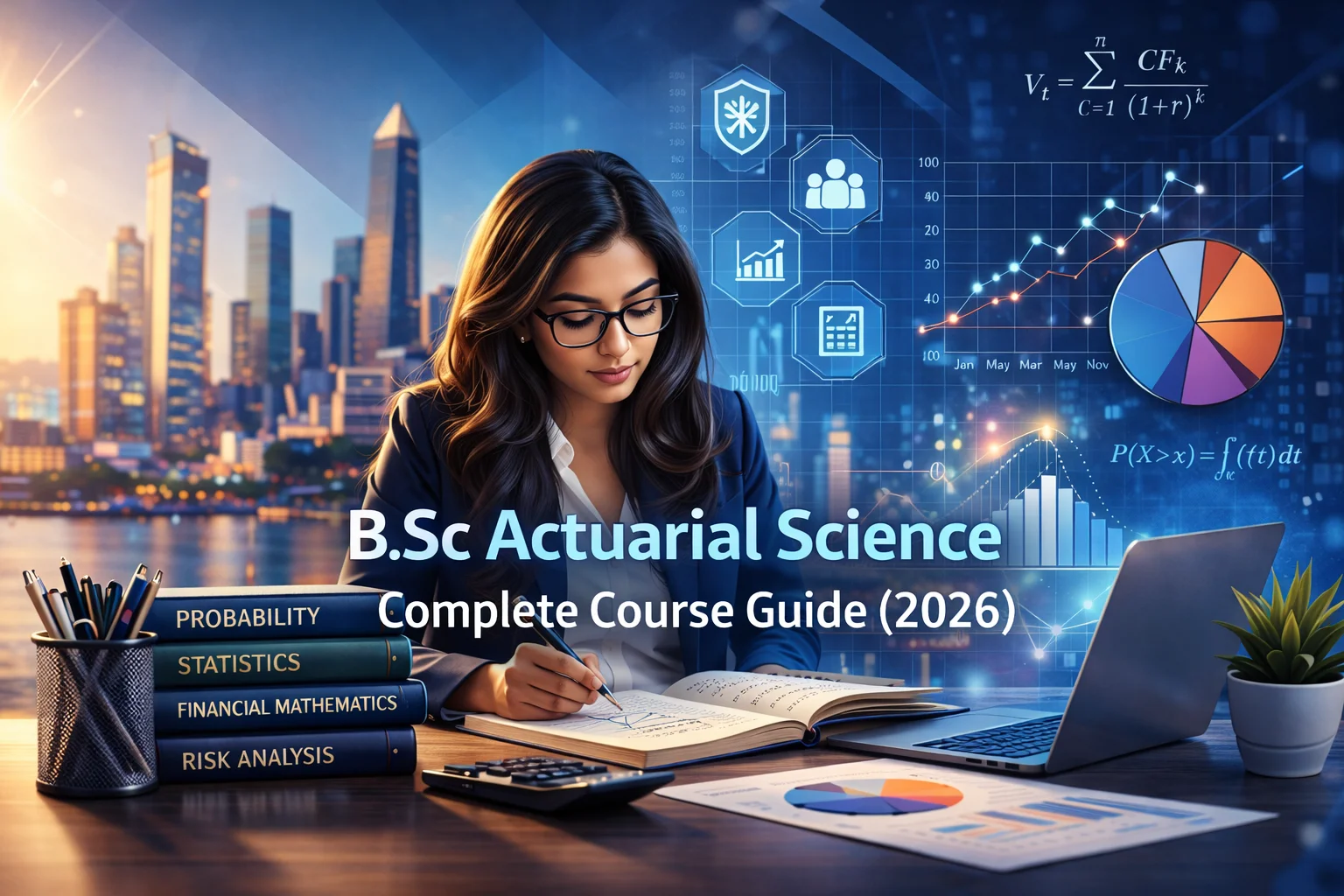
If you are someone who enjoys mathematics but also wants a high-paying, business-oriented career, actuarial science is one of the most powerful options available today. It sits at the intersection of mathematics, finance, statistics, and risk management, making it one of the most intellectually demanding yet rewarding fields.
A B.Sc Actuarial Science degree is not just about studying numbers-it is about learning how to predict financial risks, design strategies, and help organizations make billion-dollar decisions under uncertainty.
With industries like insurance, banking, fintech, and consulting increasingly relying on risk modeling, actuarial professionals are becoming essential. This makes the course highly relevant, future-proof, and globally valuable.
Table of Contents
What is B.Sc Actuarial Science
B.Sc Actuarial Science is a three-year undergraduate program focused on applying mathematical and statistical methods to evaluate financial risks and uncertainties.
Unlike general mathematics courses, this program is application-driven, meaning you learn how numbers influence real-world financial decisions.
The course trains you to:
- Measure and manage financial risks
- Build predictive models using probability
- Analyze insurance policies and investment risks
- Support strategic decision-making in uncertain environments
Actuaries are often referred to as “financial risk architects” because they design systems that protect companies from potential losses.
Course Highlights
Before diving deeper, here’s a quick snapshot of the course:
- Course Level: Undergraduate
- Duration: 3 years (6 semesters)
- Eligibility: 10+2 with Mathematics
- Admission: Merit-based / entrance exams
- Average Fees: ₹50,000 – ₹3,00,000 per year
- Career Path: Actuary, Risk Analyst, Financial Analyst
Eligibility Criteria
To pursue this course, students must meet both academic and skill-based requirements.
Academic Requirements
- Completion of 10+2 from a recognized board
- Mathematics or Statistics as a core subject
- Minimum 50–60% marks (varies by institution)
Skills That Give You an Edge
Actuarial science is not for everyone-it demands a specific mindset.
- Strong numerical and analytical ability
- Logical thinking and problem-solving skills
- Interest in finance, business, and economics
- Ability to work with data and patterns
Students who enjoy solving complex problems and working with data tend to perform well in this field.
B.Sc Actuarial Science Syllabus
The syllabus is designed to gradually move from core mathematics to advanced financial applications.
Foundation Subjects
These subjects build your core analytical base:
- Probability and Statistics
- Calculus and Linear Algebra
- Financial Mathematics
- Economic Principles
Core Actuarial Subjects
These subjects define the specialization:
- Actuarial Mathematics
- Risk Theory
- Survival Analysis
- Insurance and Pension Models
Applied and Industry-Focused Subjects
Modern programs integrate practical skills:
- Financial Modeling
- Data Analytics in Finance
- Business Finance and Accounting
- Statistical Software (R, Excel, Python basics)
Practical Exposure
- Case studies based on real financial scenarios
- Projects involving risk analysis
- Internships in finance or insurance sectors
This practical exposure is what differentiates actuarial science from purely theoretical degrees.
Actuarial Exams & Certification Path
One of the most important aspects of this field is that your career growth depends heavily on professional exams.
To become a certified actuary in India:
- Clear ACET (Actuarial Common Entrance Test)
- Register with the Institute of Actuaries of India (IAI)
- Pass multiple actuarial exams
Exam Structure
- Core Principles (Mathematics, Probability, Statistics)
- Core Practices (Risk and Finance)
- Specialist Levels (Advanced topics)
Important Insight
- Your salary increases significantly with each exam cleared
- Many students start clearing exams during their degree
This dual pathway (degree + certification) makes actuarial science unique and highly rewarding.
Course Fees Structure
The cost of pursuing this course depends on the institution.
Average Fee Range
- Government colleges: ₹50,000 – ₹1 lakh per year
- Private universities: ₹1 lakh – ₹3 lakh per year
What Influences Fees
- Industry exposure and internships
- Faculty expertise
- Placement support
- Infrastructure and labs
While fees may seem moderate compared to other professional courses, the real investment lies in time and effort for clearing actuarial exams.
Admission Process
The admission process is relatively simple but varies across institutions.
Common Admission Routes
- Merit-based (based on 12th marks)
- Entrance exams:
- CUET
- ACET
- University-specific tests
Step-by-Step Process
- Fill application form
- Submit academic documents
- Appear for entrance exam (if required)
- Merit list and counseling
- Final admission
Career Opportunities After B.Sc Actuarial Science
Actuarial science offers some of the most stable and high-paying roles in finance.
Top Job Roles
- Actuarial Analyst
- Risk Analyst
- Financial Analyst
- Insurance Underwriter
- Investment Consultant
Industries Hiring
- Insurance companies
- Banking and financial institutions
- Consulting firms
- Investment and asset management companies
Salary After B.Sc Actuarial Science
Salary growth in this field is directly linked to skills and certifications.
Salary Breakdown
- Entry-level: ₹3 LPA – ₹6 LPA
- With 2–3 exams cleared: ₹6 LPA – ₹12 LPA
- Qualified actuary: ₹15 LPA – ₹30 LPA+
Key Insight
Actuarial science is one of the few careers where:
- Salary growth is predictable
- Promotions depend on exam progression
- Top professionals earn globally competitive salaries
Scope of Actuarial Science
The demand for actuaries is growing rapidly due to increasing financial complexity and risk management needs.
High-Growth Areas
- Insurance and reinsurance
- Investment banking
- Financial risk management
- Data-driven finance (fintech)
Actuarial professionals are in demand not only in India but also internationally, making it a globally portable career.
Advantages of Choosing This Course
- One of the highest-paying finance careers
- Strong global demand
- Clear career progression path
- Combines mathematics with business applications
- Opportunities in multiple industries
Challenges You Should Know
- Requires strong mathematical foundation
- Professional exams are tough and time-consuming
- Requires long-term commitment and discipline
- Competitive at higher levels
Students must be prepared for continuous learning and consistent effort.
Final Thoughts
B.Sc Actuarial Science is not just a degree-it is a career system that combines education with professional certification. It rewards those who are disciplined, analytical, and committed to long-term growth.
If you are confident in your mathematical ability and willing to invest time in clearing actuarial exams, this field can offer exceptional financial rewards, global opportunities, and long-term career stability.
FAQs
What is B.Sc Actuarial Science?
B.Sc Actuarial Science is a three-year undergraduate program that focuses on mathematics, statistics, and financial risk analysis. It prepares students to evaluate uncertainty and support decision-making in finance, insurance, and investment sectors.
What is the eligibility for B.Sc Actuarial Science?
Students must complete 10+2 with Mathematics or Statistics as a compulsory subject from a recognized board. Most colleges require at least 50–60% marks, while some may conduct entrance exams for admission.
What is the duration of B.Sc Actuarial Science?
The course duration is three years, divided into six semesters. Some universities may offer extended programs or integrated courses that include advanced actuarial training or professional certification support.
What subjects are included in this course?
The course includes actuarial mathematics, probability, statistics, financial modeling, risk management, economics, and business finance. It also includes practical training through case studies, software tools, and real-world financial applications.
What is the salary after B.Sc Actuarial Science?
Entry-level salaries range from ₹3 LPA to ₹6 LPA. With actuarial exams cleared and experience gained, professionals can earn ₹10 LPA to ₹30 LPA or more in advanced roles.
Is actuarial science a good career option?
Yes, actuarial science is a highly rewarding career with strong demand, high salary potential, and global opportunities. It is ideal for students interested in mathematics, finance, and analytical problem-solving.
What jobs can I get after this course?
Graduates can work as actuarial analysts, risk analysts, financial analysts, insurance underwriters, or consultants in industries like insurance, banking, consulting, and investment management.
What is the ACET exam?
ACET is the Actuarial Common Entrance Test conducted by the Institute of Actuaries of India. It is the first step for students who want to begin their professional actuarial certification journey.
Can I become an actuary after this course?
Yes, but you must clear multiple professional actuarial exams conducted by recognized bodies. The degree provides foundational knowledge, while certifications are required to become a fully qualified actuary.
Is actuarial science harder than CA or engineering?
Actuarial science is considered challenging due to its complex mathematics and rigorous exam structure. However, difficulty depends on individual interest, consistency, and ability to understand analytical and financial concepts.