

Key takeaways
- DMIT is uniquely suited for children under 10 because it reads fingerprints, requiring no self-reflection, questionnaires, or prior academic history.
- The most actionable insight for young children is learning style, whether visual, auditory, or kinesthetic, so parents can stop teaching the wrong way.
- DMIT cannot diagnose dyslexia, ADHD, or predict academic performance; misrepresenting these capabilities can cause real harm to children and families.
- Use DMIT findings to adapt home learning, guide extracurricular choices, and have productive teacher conversations, not to label or limit a child.
- Career guidance from DMIT only becomes meaningful from Class 8 onward, when combined with psychometric assessment and aptitude testing.

Most career assessment tools are designed for teenagers. They assume the child has enough self-awareness to answer questions about their interests, enough academic history to show aptitude patterns, and enough life experience to imagine different futures.
For a six-year-old, none of that applies.
And yet, the decisions made in those early years – how a child is taught, what activities they are encouraged in, how their learning environment is structured – shape their confidence, their relationship with learning, and ultimately their trajectory far more than any decision made at sixteen.
DMIT is the only assessment tool that works meaningfully for young children, because it does not ask them to perform, answer questions, or reflect on themselves. It reads their fingerprints, which have been fully formed since before they were born.
This guide is for parents of children between ages 4 and 10: what DMIT can tell you at this age, what it cannot, and how to use the findings to genuinely support your child’s early development.
Why Early Assessment Matters More Than Most Parents Realise
The human brain is most neuroplastic – most capable of forming new connections and adapting to new inputs – in the first ten years of life. The learning habits, confidence patterns, and self-beliefs established during this window are disproportionately durable.
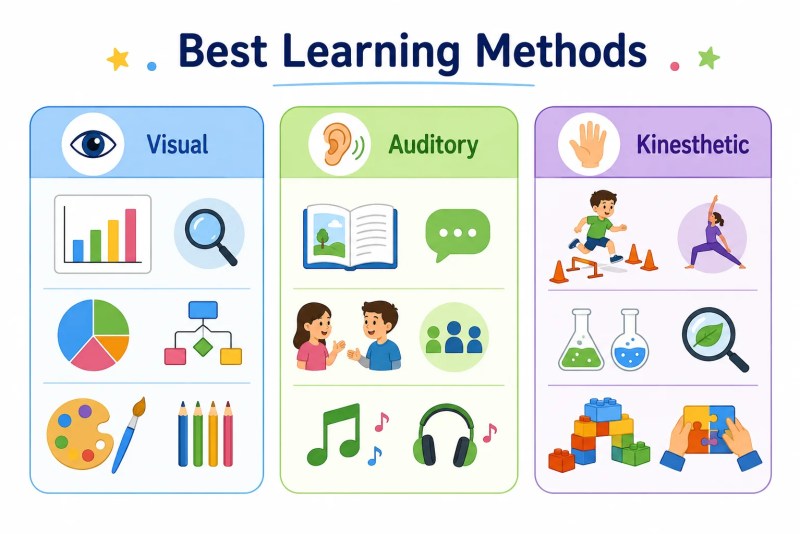
A child who experiences their natural learning style being constantly frustrated in school – who is a visual or kinesthetic learner in a predominantly auditory classroom – does not just struggle with the content. They begin to build a story about themselves: that they are slow, that learning is hard, that they are somehow less capable than the children around them.
That story, once established, is genuinely difficult to undo.
DMIT at an early age does not predict your child’s career. It does something more immediately valuable: it tells you how your child learns best right now – so you can stop teaching them the wrong way.
What DMIT Can Tell You About a Child Under 10
Learning style is the most immediately actionable insight from a DMIT report for young children. The report identifies whether your child is predominantly a visual, auditory, or kinesthetic learner – or a blend.
A visual learner under 10 needs colour, diagrams, and visual organisation. They learn their multiplication tables more easily through colour-coded charts than through chanting. They remember stories when they can picture them. They benefit from teachers who write things on the board and from parents who use visual aids at home.
An auditory learner absorbs information through sound and rhythm. Songs, rhymes, verbal explanation, and discussion work far better than silent reading. Reading aloud together activates their strongest learning channel. Background music (usually instrumental) can genuinely improve their concentration.
A kinesthetic learner needs to physically engage with material. They learn to count by touching and moving objects. They understand scientific concepts by doing experiments, not reading about them. Sitting still for extended periods is not disobedience – it is a neurological mismatch. These children often need frequent movement breaks built into their study routine.
Dominant intelligence types – the DMIT report shows which of Gardner’s eight intelligences appear naturally strongest. For a young child, this is most useful not for career planning but for identifying which activities will build confidence fastest.
A child with strong musical intelligence will feel genuinely capable and proud the first time they pick up an instrument and find it comes naturally. That experience of competence – of being good at something – is enormously important to early confidence development.
A child with strong bodily-kinesthetic intelligence will thrive in physical activities, dance, or hands-on craft – and may need those experiences to feel genuinely successful before they can sustain motivation in more abstract academic domains.
Brain lobe activity distribution tells you something about how the child processes different types of information – whether they tend toward analytical thinking, creative visual processing, language-based reasoning, or physical awareness. This is most useful for parents trying to understand why a child who seems bright in some contexts struggles in others.
What DMIT Cannot Tell You About a Child Under 10
Being clear about these matters – because overstating what the tool can do leads to misuse that can harm a child.
DMIT cannot predict specific academic performance: A child with high logical-mathematical intelligence in their DMIT profile will not automatically excel at school maths. They have the natural wiring to find it easier – but the quality of teaching, the learning environment, and their emotional state all determine actual performance.
DMIT cannot diagnose any learning difficulty or developmental condition: If you suspect your child has dyslexia, ADHD, autism spectrum characteristics, or any other condition, you need a qualified educational psychologist or paediatrician. DMIT is not a clinical tool, and any provider who suggests it can identify these conditions is misrepresenting the science.
DMIT cannot determine your child’s career: A report for a seven-year-old should not produce a career recommendation list, and if it does, that section should be treated as illustrative background – not guidance. Career direction requires interests, values, life experience, and personality dimensions that a young child has simply not developed yet.
DMIT cannot replace observation: The single most valuable dataset you have about your child is what you observe directly – what lights them up, what drains them, when they lose track of time because they are so engaged. The DMIT report should confirm and contextualise those observations, not override them.
How to Use DMIT Results to Support a Child Under 10
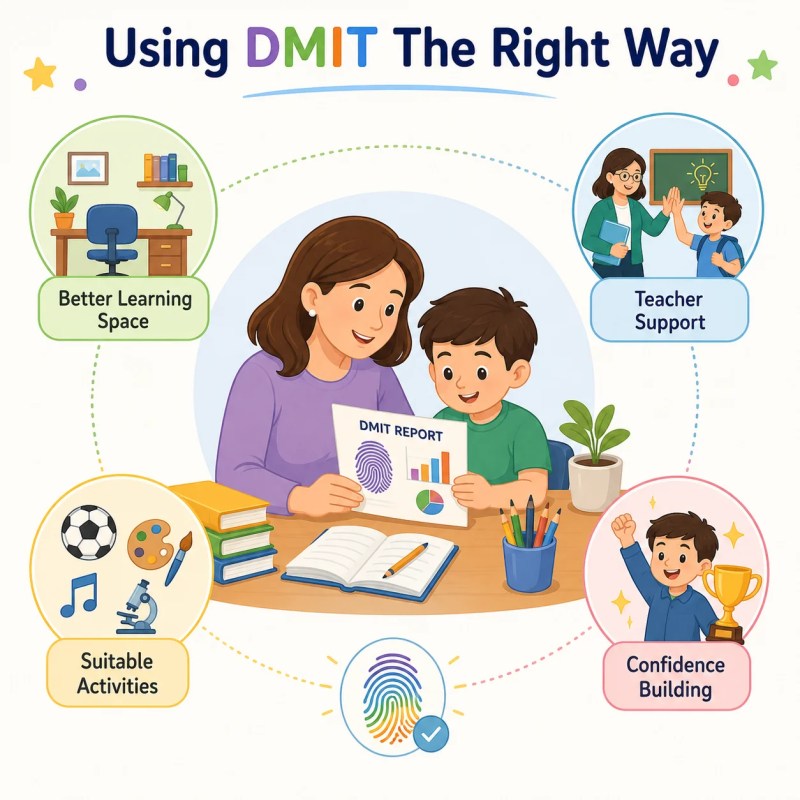
Adapt their home learning environment: If the report shows a dominant kinesthetic learning style, create a home environment where learning happens through activity. Science kits, building blocks, art supplies, and physical exploration of concepts will accomplish more than extra worksheets.
Talk to their teacher: A DMIT report gives you language and evidence to have a productive conversation with your child’s teacher about how they learn best. Most teachers are responsive when a parent brings structured information rather than just expressing frustration. “My child’s learning style assessment shows strong kinesthetic preference – are there ways you could incorporate more hands-on tasks for her?” is a much more productive conversation than “she hates sitting still.”
Choose extracurriculars based on intelligence strengths: Rather than picking activities because they are popular or prestigious, choose activities that align with your child’s dominant intelligence types. The goal at this age is to give them repeated experiences of being genuinely good at something – because that confidence generalises into academic motivation.
Avoid using the report to label your child: The most dangerous misuse of a DMIT report for a young child is telling them – directly or indirectly – that they are “not a language person” or “not built for maths.” Young brains are extraordinarily plastic. Intelligence tendencies are starting points, not conclusions. The report should expand the conversations you have about your child’s potential; never close them.
The Right Age to Take a DMIT Test
DMIT can technically be taken from age 4 onward, once the fingerprint ridges are fully formed and stable. In practice, different age windows offer different kinds of value:
Ages 4–6: Primarily useful for identifying learning styles to guide the early schooling environment and home learning approach.
Ages 7–9: Learning style plus early intelligence profiling. Useful for choosing primary school enrichment activities and identifying any areas where the current learning approach is working against the child’s natural style.
Ages 10–12: A more complete intelligence profile becomes available and can begin to inform early thinking about subject interests heading into secondary school, without yet making any binding decisions.
For career guidance in any meaningful sense, the DMIT report’s insights become most useful from Class 8 onward, when they can be combined with psychometric assessment and aptitude testing.
FAQs
Is DMIT safe for children under 10?
Yes. A child places fingers on a digital scanner for seconds. No ink or pressure involved. Mind Genics conducts assessments from age 4 onward safely.
Can DMIT detect dyslexia or ADHD in children?
No. DMIT maps learning styles and intelligence tendencies only. For learning disabilities or ADHD concerns, consult a qualified educational psychologist or developmental paediatrician.
Best DMIT insight for children aged 4 to 8?
Learning style. Knowing whether your child learns visually, auditorially, or kinesthetically lets parents adapt homework and study activities effectively.
How do I explain the DMIT test to my young child?
Tell them a special screen shows how their brain learns best. The process is quick and gentle. Most young children find it interesting.
Should I change my child’s school based on DMIT findings?
No. Use Mind Genics findings to speak with current teachers first. A school change should only follow multiple evidence sources, not one report.
Does low interpersonal intelligence mean social problems?
No. Lower scores often reflect introversion, not social difficulty. Introverted children form deep friendships. Consult a child specialist if genuine concerns exist.
How is DMIT different for children versus teenagers?
The fingerprint analysis is identical. For young children, Mind Genics focuses on learning style only. Career guidance becomes appropriate from around age 13.
Can a DMIT report get my child extra school support?
It supports teacher conversations about learning styles. For formal school support programmes, certified educational psychologist reports are required. Treat DMIT as supplementary context.
Should artistic intelligence children skip academics?
No. Creative strengths build confidence that motivates all learning, including academics. Use them as an entry point, not a replacement for core subjects.
Should I redo my child’s DMIT test at age 10?
Fingerprints never change, so a new scan is unnecessary. However, a fresh Mind Genics counselling session at age 10 applies the same data meaningfully.

