

Numbers in a report mean very little until you see what they look like in a real person’s life.
DMIT assessments are conducted for thousands of students across India every year. The patterns that emerge – where the insights land, where families push back, where the follow-through makes a real difference – tell a more complete story about the tool than any explanation of how it works.

The following case studies are composite profiles built from real counselling scenarios. Names and identifying details have been changed to protect privacy. Each case illustrates a different dimension of how DMIT Test Results create genuine value – and where good counselling is essential to make that value real.
Case Study 1: The Science Student Who Should Have Been Designing

Student profile: Aryan, Class 11, Science (PCM) stream, Pune
Family background: Father is a civil engineer. Strong expectation – never explicitly stated but clearly felt – that Aryan would follow an engineering path.
Presenting concern: Aryan was performing adequately in school – not failing, but never engaged. He completed assignments but showed no curiosity beyond the minimum. His class teacher had flagged him as “capable but underachieving.”
DMIT findings: Aryan’s report showed dominant occipital and parietal lobe activity, with whorl patterns concentrated on his spatial-associated fingers. His top intelligence types were spatial (highest), bodily-kinesthetic (second), and logical-mathematical (third). His linguistic intelligence was in the moderate range. The report’s career cluster recommendations led strongly toward architecture, product design, industrial design, and visual communication.
What happened in the counselling session: When the counsellor showed Aryan the spatial intelligence finding and asked him what he thought, he was quiet for a moment. Then he said, “I draw buildings. I have a notebook at home full of building designs I’ve drawn since I was nine. I never told anyone because I thought it was a waste of time.”
His father, who was present, had never seen the notebook. He had assumed Aryan’s quietness was laziness. The report reframed the conversation entirely – from “why aren’t you trying harder?” to “what have you been building in that notebook?”
Outcome: Aryan did not immediately leave PCM – he was already in Class 11. But the family began seriously exploring B.Arch as a college pathway. His counsellor connected them with an architect for an informational conversation. Aryan finished Class 11 with markedly better engagement, reporting that knowing his spatial strength was real gave him something to study toward rather than just through.
Key insight: DMIT does not always change the stream. Sometimes it changes the relationship a student has with their current path by connecting it to a future that actually excites them.
Case Study 2: The Arts Student Who Was Told She Was in the Wrong Stream

Student profile: Priya, Class 9, considering stream selection, Indore
Family background: Both parents are accountants. Commerce was strongly preferred by the family. Science was considered the fallback. Arts was never mentioned.
Presenting concern: Priya’s Class 9 marks were average across the board – nothing that clearly pointed toward any stream. She described herself as “not really good at anything.”
DMIT findings: Priya’s report showed high temporal lobe activity with a strong loop-dominant fingerprint profile. Her top intelligence types were linguistic (highest), interpersonal (second), and musical (third). Her logical-mathematical score was in the lower range, and her spatial score was moderate. Career cluster recommendations pointed strongly toward mass communication, journalism, psychology, law, and performing arts.
What happened in the counselling session: When the counsellor read out the linguistic and interpersonal findings, Priya’s mother said, almost dismissively: “She does talk a lot.” The counsellor asked Priya what subjects she found herself thinking about outside of school. Priya said, “I wrote a story last month, just for myself. And I watch a lot of documentaries about crime and psychology.”
The counsellor used this to explain how BA programmes in psychology, journalism, and eventually law or counselling are built precisely for this profile – and that graduates from these fields in India today, particularly in content, media, psychology, and legal services, are finding strong career pathways.
Outcome: Priya chose the Humanities stream with psychology and political science. Her marks in Class 11 improved significantly – not because the subjects were easier, but because she was finally studying something that felt meaningful to her. Her mother later told the counsellor it was the first time Priya had come home from school and talked about what she had learned.
Key insight: DMIT is often most powerful for students who have been told, implicitly or explicitly, that their natural inclinations are not valuable. Naming those inclinations with data changes the family dynamic.
Case Study 3: The Child Who Was Called Hyperactive

Student profile: Rohan, age 8, Class 3, Delhi
Family background: Parents had been told by the school that Rohan was “difficult to manage” and was disrupting class. They were anxious and had started exploring whether he had ADHD.
Presenting concern: Rohan could not sit still during lessons, frequently left his seat, struggled to complete written work, but was described by his parents as highly energetic, physically skilled, and completely engrossed when doing anything with his hands.
DMIT findings: Rohan’s report showed dominant cerebellar and occipital activity with a high proportion of arch patterns – a profile strongly associated with bodily-kinesthetic and spatial intelligence. His learning style indicator showed a strong kinesthetic preference with visual as secondary. There was no clinical finding of any kind – DMIT cannot produce those – but the profile made very clear that Rohan was a kinesthetic learner in an almost exclusively auditory-linguistic classroom environment.
What happened in the counselling session: The counsellor was careful to explain clearly to the parents that the DMIT report was not a diagnosis and that if they had genuine concerns about ADHD, a developmental paediatrician was the right next step. But the counsellor also helped the parents understand that kinesthetic learners consistently present exactly as Rohan did in conventional classroom settings – not because something is wrong, but because the delivery is fundamentally mismatched.
Armed with the report, the parents had a very different conversation with the school. They asked whether Rohan could have more hands-on learning materials, be given permission to stand at the back of the class when needed, and have his comprehension tested through demonstration rather than written answers. The school, presented with a structured report rather than just parental complaints, was receptive.
Outcome: Within two months, the school reported a significant decrease in “disruptive” behaviour. Rohan’s parents described him as calmer at home too – the report had changed how they engaged with him, not just how the school did. They had stopped asking him to sit still and read and started working through physical models and activities instead.
Key insight: DMIT for young children often matters most not for what it predicts about the future, but for how it changes the present – the daily experience of a child in their learning environment.
Case Study 4: The Student Who Changed Streams at Class 11 Entry
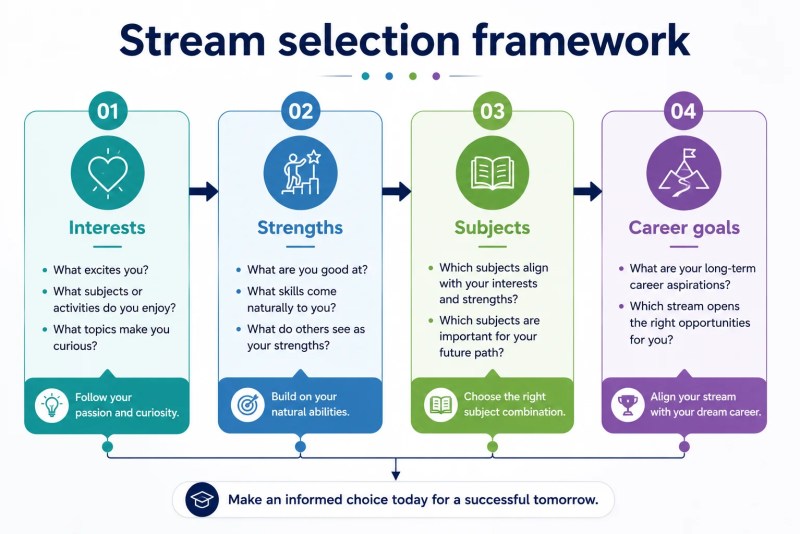
Student profile: Meera, Class 10 result just received, Commerce stream under family consideration, Bengaluru
Family background: No strong professional expectation. Parents were described as open-minded but uncertain. They had heard about DMIT from a neighbour and came in primarily out of curiosity.
Presenting concern: Meera had scored well in Class 10 – 87% aggregate, with her strongest marks in science and her weakest in mathematics. She described liking science but “not the formula part – more the why behind things.”
DMIT findings: Meera’s report showed high parietal and occipital lobe activity. Her top intelligence types were naturalistic (highest), logical-mathematical (second – but the counsellor noted her score was moderate, consistent with science interest but not formula-heavy aptitude), and spatial (third). The report flagged a strong match with life sciences, environmental science, biotechnology, and healthcare pathways. Commerce-related intelligence types (linguistic, interpersonal) were in the moderate range – not strong indicators for commerce.
What happened in the counselling session: Meera lit up when the counsellor mentioned naturalistic intelligence. “I want to be a researcher,” she said. “I was going to do Commerce because my cousin did well in it. But I don’t actually want to work in a bank.”
The counsellor walked through the Science (PCB) pathway – BSc Biotechnology, BSc Environmental Science, and eventually research or healthcare careers – showing Meera and her parents concrete Indian college pathways and career outcomes.
Outcome: Meera chose Science (PCB). Two years later, she was admitted to a BSc Biotechnology programme at a reputed Bengaluru college. Her parents sent a message to the counsellor on the day the admission came through.
Key insight: Sometimes DMIT prevents a misalignment that would have been perfectly acceptable by conventional standards – Commerce for an 87% scorer is not an irrational choice – but that would have quietly cost a student ten years of working against their grain.
Case Study 5: The Engineer Who Realised He Was in the Wrong Role

Student profile: Vikram, 26, Software Engineer, Mumbai – adult career change consultation
Background: Vikram had completed B.Tech in Computer Science and was three years into a software development role. He was technically competent, and his performance reviews were good. But he described feeling increasingly hollow at work – like he was “going through motions.”
DMIT findings: Vikram’s top intelligence types were interpersonal (highest), linguistic (second), and logical-mathematical (third – strong enough to have supported his engineering education but not dominant). Career cluster recommendations pointed strongly toward management, consulting, product management, training, and leadership roles.
What happened in the counselling session: The counsellor noted that Vikram’s logical-mathematical score was solid – it explained why he had succeeded in engineering – but that interpersonal and linguistic dominance in someone spending all day writing code alone was a significant energy drain. “Does your work involve much interaction with people?” the counsellor asked. “Almost none,” Vikram said. “I sit with headphones in for eight hours.”
The counsellor helped Vikram see that his technical background was an asset, not something to abandon – but that he was using it in the wrong mode. Product management, technical consulting, and developer relations roles all require engineering knowledge combined with exactly the interpersonal and communication strengths his profile showed.
Outcome: Vikram enrolled in a product management course while continuing his current role. Within fourteen months, he had transitioned into a junior product manager role at a Bengaluru startup. He described it as the first time he had been genuinely excited to go to work.
Key insight: DMIT is not only for students. Adults experiencing career dissatisfaction despite competence often have a mismatch between their role and their dominant intelligence types – and that mismatch is entirely fixable once it is identified.
FAQS
Are Mind Genics DMIT outcomes reliable for all students?
Outcomes depend on counsellor quality and family follow-through. Mind Genics includes a certified counsellor-led session with every assessment because reports alone produce weaker results.
How quickly do students benefit after a Mind Genics DMIT assessment?
Most notice engagement shifts within four to eight weeks. Career clarity deepens over months as students explore directions the Mind Genics report identifies.
What if DMIT shows strengths parents disapprove of?
Mind Genics counsellors present data neutrally, show concrete career pathways, and facilitate conversations where both student profile and family concerns are heard.
Can Mind Genics DMIT find hidden talents in average students?
Yes. Students with strong spatial or kinesthetic profiles who underperform academically become visible through data, transformative for students who doubted their abilities.
Is DMIT useful for career-confident students?
Yes. Mind Genics DMIT validates chosen directions, identifies best-fit roles within a field, and surfaces mismatches worth examining before committing to further study.
How does Mind Genics handle report and behaviour mismatches?
Counsellors treat mismatches as insightful cases, exploring developmental factors and environmental influences to reveal strengths the student may have been conditioned to suppress.
Do DMIT results vary across different socioeconomic backgrounds?
No. Fingerprints form before any environmental influence. Mind Genics biological data is consistent across all backgrounds. How tendencies develop differs, but the innate profile does not.
Can adults use Mind Genics DMIT for a career change?
Yes. Fingerprint data is valid for life. Adults with role-intelligence mismatches benefit from Mind Genics DMIT by mapping their strengths to better-suited career directions.
How do parents ensure children act on DMIT guidance?
Mind Genics designs multi-session guidance where students explore directions through real conversations and experiences. Sustained momentum produces lasting career clarity.
What if the Mind Genics DMIT report feels inaccurate?
Raise it with the Mind Genics counsellor. Good counsellors use every contradiction to deepen guidance rather than defend the report, exploring context and nuances.

