
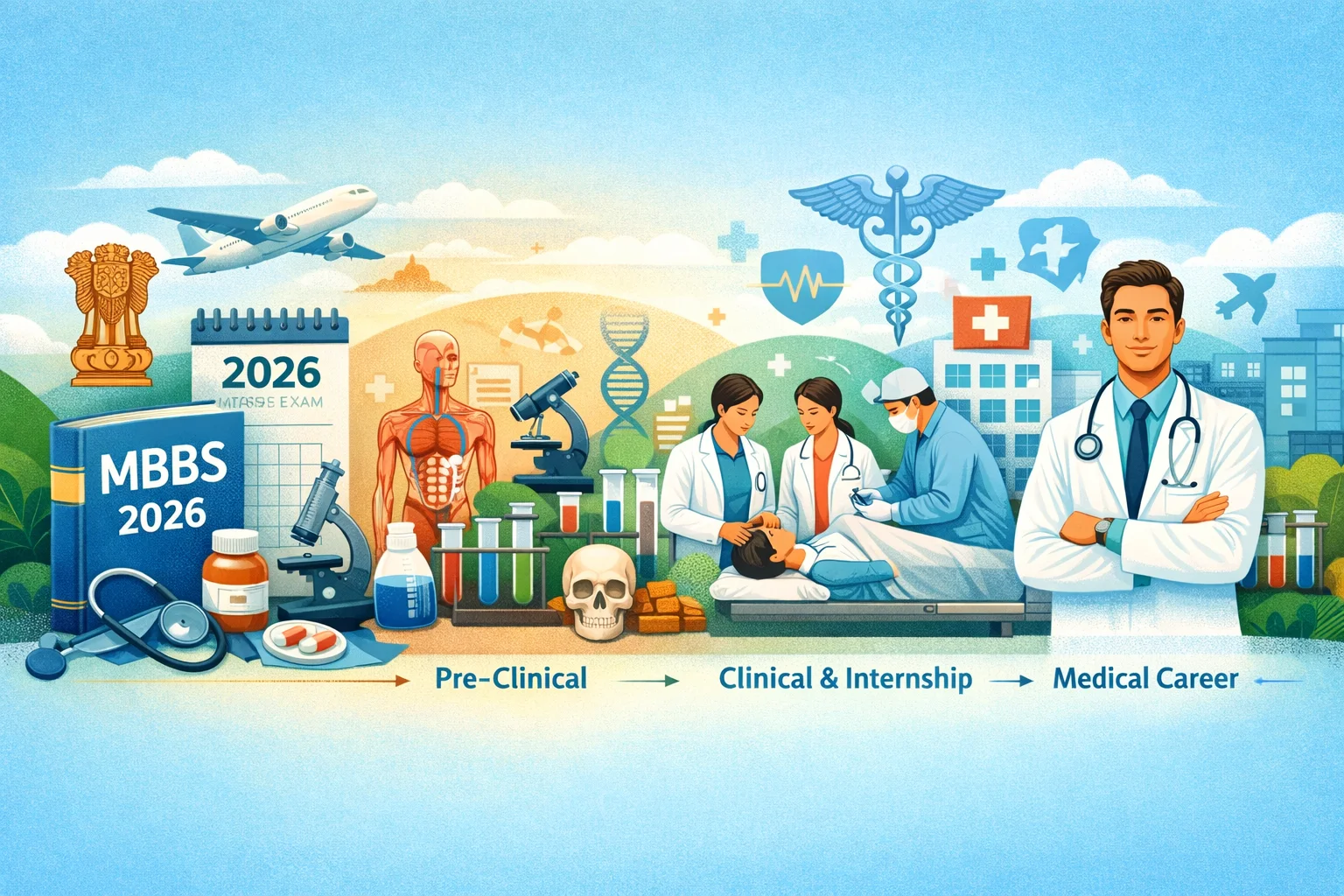
Becoming a doctor remains one of the most respected and secure career choices in India. If you are planning to pursue medicine in 2026, the first step is understanding everything about the MBBS degree — from its full form and course structure to admission process, eligibility criteria, fees, and career opportunities.
This updated 2026 guide gives you accurate, structured, and practical insights to help you make informed decisions.
Table of Contents
What is the Full Form of MBBS?
MBBS stands for Bachelor of Medicine and Bachelor of Surgery.
The term originates from Latin:
- Medicinae Baccalaureus – Bachelor of Medicine
- Baccalaureus Chirurgiae – Bachelor of Surgery
Although the name suggests two degrees, MBBS is a single undergraduate program that integrates both medical and surgical training.
In India, MBBS education is regulated by the National Medical Commission (NMC), which sets academic standards, internship guidelines, and licensing requirements.
MBBS Course Structure in India (As per NMC Guidelines)
Total Duration: 5.5 Years
- 4.5 Years Academic Study
- 1 Year Compulsory Internship (CRMI)
Phase I – Pre-Clinical (First Professional MBBS)
Duration: 1 Year (Earlier 1.5 Years)
Important Update: Under the newer competency-based curriculum (CBME), this phase is 1 year, not 1.5 years.
Subjects:
- Anatomy
- Physiology
- Biochemistry
Focus:
- Structure and function of the human body
- Basic scientific foundation of medicine
- Early clinical exposure was introduced
Phase II – Para-Clinical (Second Professional MBBS)
Duration: 1.5 Years
Subjects:
- Pathology
- Microbiology
- Pharmacology
- Forensic Medicine
- Community Medicine (Part 1)
Focus:
- Disease mechanisms
- Diagnostic sciences
- Drug action and prescription
- Legal aspects of medicine
This is where students begin understanding how diseases develop and how medicines work.
Phase III – Clinical (Final Professional MBBS)
Duration: 2 Years (Divided into Part 1 & Part 2)
Major Clinical Subjects:
- General Medicine
- General Surgery
- Pediatrics
- Obstetrics & Gynecology
- Orthopedics
- Ophthalmology
- ENT
- Dermatology
- Psychiatry
- Anesthesia
- Radiology
- Emergency Medicine
- Community Medicine (Part 2)
Focus:
- Patient interaction
- Clinical examination
- Diagnosis
- Treatment planning
- Case presentation
This is the most practical and hospital-oriented stage.
Compulsory Rotating Medical Internship (CRMI)
Duration: 1 Year
After clearing the final MBBS exams:
Students must complete a supervised internship before getting permanent registration from NMC.
Internship Rotations Include:
- Medicine
- Surgery
- OBG
- Pediatrics
- Community Medicine
- Emergency
- Orthopedics
- Electives
During Internship:
- Manage real patients
- Perform minor procedures
- Assist in surgeries
- Handle emergency cases
- Improve communication skills
After completing internship + NMC registration →
✔ You can legally practice as a doctor in India.
MBBS Admission 2026
Admission to MBBS in India is conducted through NEET-UG 2026.
NEET (National Eligibility cum Entrance Test) is organised by the National Testing Agency (NTA) and remains the only entrance examination for MBBS admission in India.
Expected NEET 2026 Timeline
- Registration Start: February 8, 2026
- Last Date to Apply: March 8, 2026 (9:00 PM)
- Correction Window: March 10–12, 2026
- Admit Card Release: Tentatively late April 2026
- Exam Date: May 3, 2026
- Result Announcement: Tentatively June 2026
- Counselling & Seat Allotment: July–September 2026
Candidates must regularly check official NTA notifications for confirmed dates.
MBBS Admission Process 2026
Step-by-step process:
- Register for NEET-UG online
- Upload required documents
- Download the admit card
- Appear for the NEET exam
- Check the result and the All India Rank
- Participate in the All India Quota (AIQ) or State Counselling
- Seat allotment and college reporting
Admission is strictly based on merit and reservation guidelines.
MBBS Eligibility Criteria 2026
Candidates must fulfil the following requirements:
Educational Qualification
- Completion of 10+2 with Physics, Chemistry, Biology
- Minimum 50% aggregate in PCB (40% for reserved categories)
- English as a compulsory subject
Age Criteria
- Minimum age: 17 years by December 31, 2026
- No upper age limit
Other Requirements
- Valid NEET-UG 2026 score
- Indian citizenship / OCI eligibility
- Medical fitness certificate
MBBS Fees Structure in 2026
Fees depend on the type of institution.
Government Medical Colleges
- Annual Tuition Fees: ₹10,000 – ₹60,000
- Total Course Cost: ₹60,000 – ₹3,50,000
- Hostel Charges: ₹20,000–₹50,000 per year
- Books & Equipment: ₹40,000–₹60,000 (approx.)
Government colleges remain highly affordable but extremely competitive.
Private Medical Colleges
- Annual Tuition Fees: ₹10,00,000 – ₹28,00,000
- Total Course Cost: ₹50,00,000 – ₹1.6 Crore
- Hostel and other charges vary by institution
Private institutions offer more seats but require higher financial investment.
Financial Support for MBBS Students
Students in 2026 can explore:
- Central and state government scholarships
- NMC-approved fee reimbursement schemes
- Bank education loans with extended repayment tenure
- Merit-based private scholarships
Medical education loans often include moratorium periods until completion of the internship.
Career Opportunities After MBBS
An MBBS degree opens multiple career paths in 2026.
Postgraduate Specializations
After MBBS, candidates can pursue:
MD (Doctor of Medicine)
- Internal Medicine
- Pediatrics
- Dermatology
- Radiology
- Psychiatry
MS (Master of Surgery)
- General Surgery
- Orthopedics
- ENT
- Ophthalmology
- Neurosurgery
Admission to PG courses requires clearing NEET-PG.
Career Options Beyond Clinical Practice
Apart from hospital practice, graduates can enter:
- Public health services
- Medical research
- Healthcare administration
- Pharmaceutical industry
- Medical content and academic writing
- Armed forces medical services
Telemedicine and digital healthcare platforms are expanding rapidly in 2026, creating new opportunities for doctors.
Salary Expectations in 2026
Earnings vary by specialisation and location.
- Fresh MBBS doctor: ₹4–9 lakh per year
- 3–5 years experience: ₹10–20 lakh per year
- Specialists: ₹25 lakh to ₹1 crore+ annually
- Private practice: Income depends on patient base and city
Metropolitan cities generally offer higher salary packages.
Preparation Strategy for NEET 2026
To secure MBBS admission:
- Start preparation early (Class 11 ideally)
- Focus strongly on the NCERT textbooks
- Practice mock tests regularly
- Improve time management skills
- Strengthen conceptual clarity in Biology, Chemistry, and Physics
Consistency and disciplined revision remain the keys to success.
NEET 2026 Paper Pattern
The NEET UG 2026 exam follows the revised pre-COVID pattern, meaning all questions are compulsory. There are no internal choices or optional sections. The exam is conducted in offline mode using an OMR sheet.
Understanding the exact paper pattern helps students plan preparation, time management, and exam strategy more effectively.
NEET 2026 Exam Paper Pattern Overview
Below is a quick summary of the NEET 2026 exam structure:
NEET 2026 Pattern Summary
| Feature | Details |
|---|---|
| Conducting Authority | National Testing Agency (NTA) |
| Exam Mode | Offline (Pen–Paper OMR) |
| Total Questions | 180 (All compulsory) |
| Total Marks | 720 |
| Duration | 3 Hours (180 Minutes) |
| Subjects | Physics (45), Chemistry (45), Zoology (45), Botany (45) |
| Question Type | Multiple Choice Questions (MCQs) |
| Marking Scheme | +4 for correct, −1 for incorrect |
| Languages | 13 (English, Hindi & Regional Languages) |
MBBS Cut-Off in India (NEET-Based Admission)
Admission to MBBS in India is done through the NEET-UG exam conducted by the National Testing Agency, and counselling is regulated under the National Medical Commission.
Qualifying Cut-Off (Minimum Required to Pass NEET)
This is the basic eligibility score to participate in counselling:
- General Category: 50th percentile
- OBC/SC/ST: 40th percentile
- PwD: 45th percentile
Qualifying does NOT guarantee a seat — it only makes you eligible for counselling.
Admission Cut-Off (Actual College Cut-Off)
This is the score required to get admission in a specific college.
Approximate trends:
- Top Government Colleges (AIQ Quota): 650–720+ marks
- State Government Colleges (State Quota): 580–650 marks (varies by state quota)
- Private Colleges: 450–600 marks
- Deemed Universities: 400–550 marks
Cut-offs are usually higher in states with high competition, like Delhi, Rajasthan, UP, Maharashtra, and Karnataka.
Essential Skills for Future Doctors
Medicine is not only about academic excellence. Successful doctors must develop:
- Strong communication skills
- Empathy and compassion
- Emotional resilience
- Decision-making under pressure
- Ethical responsibility
In 2026, patient-centred care and digital literacy are increasingly important in medical practice.
Can MBBS Be Done Through Distance Learning?
No. MBBS requires laboratory training, clinical rotations, hospital exposure, and supervised internship. Therefore, it cannot be pursued through distance or online mode.
Conclusion
MBBS is more than a degree — it is a commitment to lifelong learning and patient care. The medical profession in 2026 continues to evolve with technology, digital healthcare, and specialised treatment methods.
With proper preparation, clarity about admission procedures, and realistic financial planning, aspiring students can confidently begin their journey toward becoming doctors.
If medicine is your dream, now is the time to prepare, stay focused, and take your first step toward a respected and impactful career in healthcare.
Read: Top Non-Medical Career Options for PCB Biology Students After 12th
Frequently Asked Questions
What is the full form of MBBS?
MBBS stands for Bachelor of Medicine and Bachelor of Surgery. It is an undergraduate medical degree that provides training in both medical treatment and surgical procedures. In India, it is regulated by the National Medical Commission (NMC).
What is the total duration of the MBBS course?
The MBBS program lasts 5.5 years, which includes 4.5 years of academic education and 1 year of compulsory rotating internship. The internship is mandatory for obtaining medical registration and practising legally.
Is NEET compulsory for MBBS admission?
Yes, qualifying NEET-UG is mandatory for admission to all government, private, and deemed medical colleges in India. Without a valid NEET score, candidates cannot secure an MBBS seat.
What NEET score is considered safe for MBBS in government colleges?
Generally, scoring 600+ marks out of 720 is considered competitive for government medical colleges. However, the exact cutoff varies every year depending on competition, seat availability, and category.
Can I practice as a doctor immediately after completing MBBS?
You can begin practising only after completing the one-year internship and obtaining registration from the State Medical Council or NMC. Without registration, medical practice is not legally permitted.
Is MBBS available through online or distance mode?
No, MBBS cannot be pursued through distance or online learning. The course requires laboratory training, hospital rotations, and supervised clinical practice, which must be completed physically.
What are the career options after MBBS?
After MBBS, graduates can work as general physicians, join hospitals, or pursue postgraduate specialisation such as MD or MS. They may also explore careers in research, public health, administration, or the pharmaceutical industry.