

Key Takeaways before the read
- Most classrooms serve one teaching style to thirty different learners, causing capable students to underperform simply due to a delivery mismatch.
- A class-wide learning style map shows teachers exactly how many students each delivery method reaches, giving data-backed reasons to vary instruction.
- Psychometric profiling at secondary school entry shifts counselling from reactive crisis management to proactive early identification of at-risk students.
- Psychometric software frees counsellors from data gathering, enabling group interpretation sessions and structured career guidance for every student, not just a few.
- Free online tools lack Indian student norms, professional reporting, and data security, making them unsuitable replacements for validated institutional psychometric software.
Walk into most Indian school classrooms, and you will find one teaching style serving thirty different types of minds.
The teacher explains. Students listen. Notes are written. Tests are taken. Children who absorb information auditorially and express themselves well in writing perform well. Children who think visually, learn kinesthetically, or process through discussion and collaboration often underperform – not because they are less capable, but because the delivery mechanism is wrong for how their brain works.
Schools have always known, in theory, that children are different. What they have rarely had is a systematic, evidence-based method for understanding exactly how children differ – and a practical framework for acting on that understanding at scale.
Psychometric testing gives schools that method.
What Psychometric Testing Offers Schools
Psychometric assessment in a school context is not about labelling children or ranking them against each other. It is about giving teachers, counsellors, and school administrators data they can act on – data that helps every student experience a version of education that is actually designed for them.
At the institutional level, a school that uses psychometric tools is doing something genuinely different from one that does not: it is making evidence-based decisions about how students are taught, guided, and supported, rather than defaulting to assumptions based on marks alone.
The specific value psychometric testing brings to schools falls into four areas.
Area 1: Learning Style Identification Across the Student Body
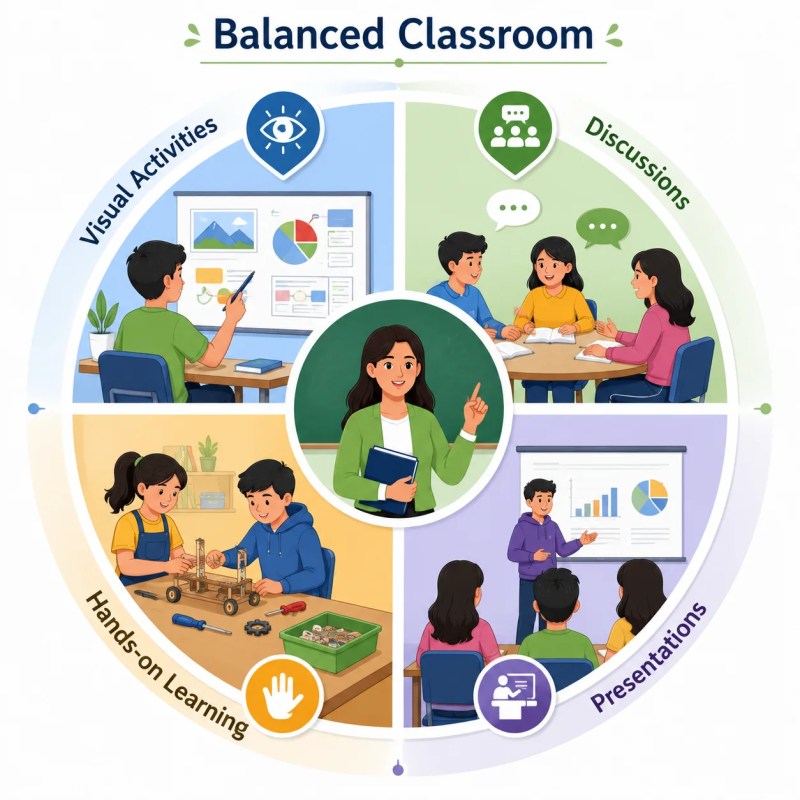
When a school administers psychometric assessments to an entire class or year group, one of the most immediately useful outputs is a learning style distribution map.
If a Class 6 of thirty students contains twelve visual learners, ten kinesthetic learners, and eight auditory learners, that information has direct implications for how lessons should be structured. A teacher who only lectures is reaching eight of those thirty students optimally. The other twenty-two are processing at a disadvantage every day.
Armed with this data, schools can:
Design blended teaching approaches that incorporate visual aids, discussion, and hands-on activities into every lesson – not as additions, but as core delivery mechanisms.
Group students strategically for project work so that kinesthetic learners get to build and create, while visual learners can design and map, and auditory learners can present and discuss.
Give teachers a legitimate, data-backed reason to vary their delivery style – which many teachers instinctively want to do but struggle to justify without supporting evidence.
Area 2: Early Identification of At-Risk Students

One of the most powerful preventive uses of psychometric assessment in schools is early identification of students whose profile puts them at high risk of disengagement – before that disengagement becomes entrenched.
A student with a strongly kinesthetic learning style and high bodily-kinesthetic intelligence who has been sitting in a predominantly lecture-based classroom for four years is not a discipline problem waiting to happen. They are a learner whose needs have been systematically unmet, and the frustration of that mismatch accumulates.
Psychometric profiling at the beginning of secondary school gives counsellors and class teachers a proactive lens. Students whose personality and learning style profiles are most mismatched with conventional academic delivery can be flagged for additional support, alternative learning approaches, or targeted counsellor check-ins – before the mismatch becomes a crisis.
This shifts school counselling from reactive to genuinely preventive: addressing root causes rather than managing symptoms.
Area 3: Stream and Subject Guidance at the Class 9–10 Transition

The Class 10 stream selection decision is the most consequential academic choice most Indian students make – and most schools handle it with minimal structured support.
A school that conducts psychometric assessments for all Class 9 students can provide every student with a data-backed, counsellor-interpreted career interest and personality profile before they choose their Class 11 stream. This transforms stream counselling from a rushed, one-size-fits-all exercise into a genuinely individualised guidance process.
The school counsellor uses the psychometric profile to:
Identify students whose natural interests align clearly with one stream and who simply need confirmation and confidence – these students need a shorter counselling intervention.
Identify students whose profile is genuinely ambiguous or conflicted – high logical-mathematical intelligence but strong artistic interests, for example – who need deeper exploration and more counsellor time.
Identify students who are at high risk of choosing a stream based purely on social or family pressure rather than genuine fit – a pattern that psychometric data can flag clearly when interest scores are low across all three conventional stream options.
Area 4: Personalised Career Counselling at Scale

School counsellors in India face an impossible workload. A single counsellor may be responsible for hundreds of students across multiple year groups, with no practical way to provide genuinely individualised career guidance to each one.
Psychometric software changes this equation.
When assessments are conducted digitally, and reports are generated automatically, the counsellor’s time is freed from data gathering and redirected entirely toward interpretation and guidance – the high-value human work that cannot be automated.
A counsellor working with psychometric software can:
Conduct class-wide assessments with minimal session time, since students complete assessments independently on computers or tablets.
Review reports for an entire year group efficiently, identifying clusters of similar profiles, outliers who need immediate attention, and students who are ready for brief guidance conversations versus those who need deeper support.
Conduct interpretation sessions in small groups of students with similar profiles – covering core guidance for the whole group before addressing individual variations – instead of scheduling thirty separate one-on-one sessions.
Build a structured career guidance programme that every student in the school receives, rather than a service available only to students whose parents specifically request it.
The Difference Between Psychometric Software and Generic Online Tests
Many schools have experimented with free online career interest surveys or personality quizzes. These have genuine limitations that matter in an institutional context:
No validated norms: Free online tools are typically not normed against an age-specific Indian student population. A test calibrated for adult professionals gives misleading results when administered to a fifteen-year-old in Bhopal.
No professional reporting: A free quiz produces a category label. Quality psychometric software produces a multi-dimensional report covering personality traits, interest areas, work values, and learning style – with enough depth for a trained counsellor to work with meaningfully.
No institutional support: Schools need a provider relationship – for training, for bulk administration, for technical support, and for data privacy compliance. A free online tool offers none of this.
No data security: Student data entered into consumer-grade online tools may be stored, shared, or used in ways that do not comply with educational data privacy standards. Professional psychometric software designed for institutional use includes appropriate data security frameworks.
How to Implement Psychometric Testing in a School: A Practical Overview
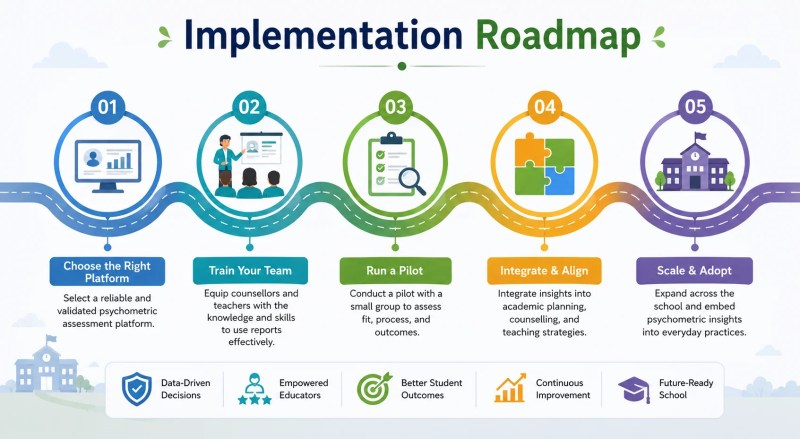
Step 1: Choose a validated psychometric software platform with age-appropriate instruments, Indian student norms, and institutional support capability.
Step 2: Train the school counsellor on both administration and report interpretation. A one-time training investment produces years of guided value. MindGenics provides full counsellor certification as part of the software onboarding.
Step 3: Start with one year group – typically, Class 9 is the highest-impact starting point given the proximity to stream selection. Run a pilot cohort, evaluate outcomes, and expand to other year groups once the process is established.
Step 4: Integrate findings into the counselling workflow. Psychometric data should feed directly into stream counselling sessions, parent meetings, and subject teacher briefings where relevant. Data that sits in a file produces no value.
Step 5: Build a school-wide culture around the language of learning diversity. The long-term value of psychometric assessment in schools is not just the individual guidance – it is the shift in how teachers, counsellors, and administrators understand and talk about student differences. That cultural shift is what produces lasting improvement in learning outcomes.
FAQs
What does psychometric testing measure in school students?
Mind Genics assessments measure personality traits, career interests, learning styles, and work values. No right or wrong answers. Results reveal how students learn best.
Which class is best for introducing psychometric assessment in schools?
Class 9 delivers the highest impact as it precedes stream selection. Earlier introduction in Class 6 supports learning style-based teaching across year groups.
How does Mind Genics software help overworked school counsellors?
Automated report generation frees counsellors from data collection entirely. They conduct group sessions for similar profiles and reserve one-on-one time for complex cases.
Can schools share Mind Genics psychometric results with parents?
Yes. Schools should clarify results measure learning tendencies for guidance only and that Mind Genics stores data securely, never sharing it with third parties.
How can teachers use psychometric data without extra training?
Start with learning style distribution. A teacher knowing 40% of students are visual learners adds diagrams into existing lessons. Small adjustments produce meaningful engagement improvements.
Do psychometric tests risk labelling students negatively?
Mind Genics training frames results as strength maps, never rankings. No student results should be shared with peers or used in any comparative context.
How does Mind Genics school software differ from HR tools?
Mind Genics uses age-appropriate instruments normed against Indian students. Corporate HR tools target working adults and produce inappropriate results on school students.
Can Mind Genics psychometric testing identify academically overlooked gifted students?
Yes. Students with strong artistic or kinesthetic profiles who underperform academically are identified early, allowing schools to build enrichment pathways before they become disengaged.
How do schools measure Mind Genics psychometric assessment effectiveness?
Through stream satisfaction surveys, engagement metrics, and counsellor caseload data tracked via Mind Genics Management Tracking System. Schools consistently report improved stream retention rates.
Is Mind Genics suitable for government and state board schools, too?
Yes. Mind Genics works across all board types and geographies, including Tier-2 towns. Contact sales@mindgenics.in to discuss a solution suited to your school.

