
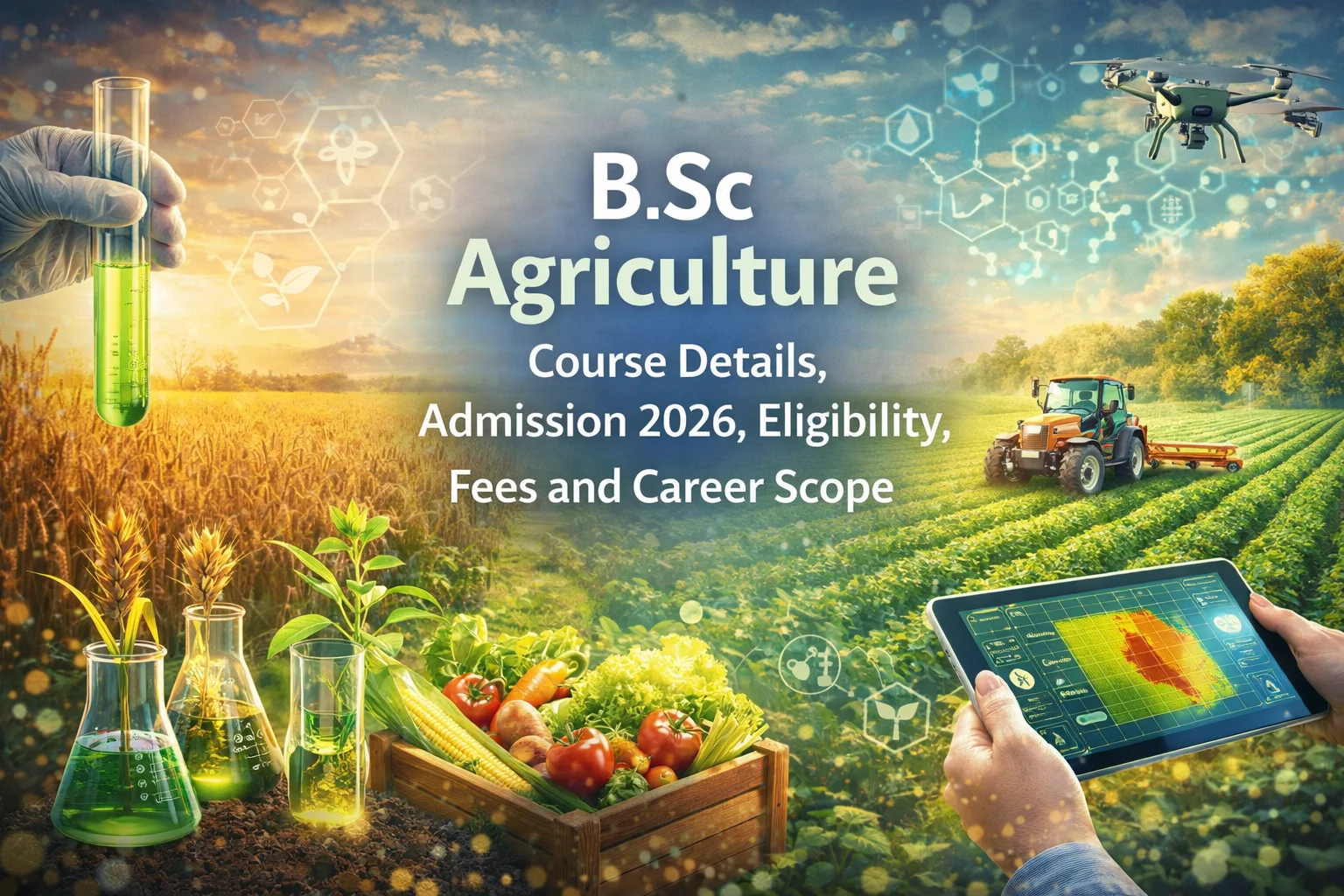
Agriculture is the backbone of India’s economy, supporting millions of livelihoods and ensuring food security for the country. With the growing population and increasing demand for sustainable farming, modern agriculture is rapidly evolving with the use of technology, scientific research, and innovative practices.
Today, agriculture encompasses not only farming, but also agribusiness, biotechnology, soil science, crop production, and agricultural engineering. Professionals in this field focus on enhancing crop yields, developing disease-resistant plants, managing natural resources, and promoting sustainable agricultural practices.
The B.Sc Agriculture course is a highly sought-after undergraduate program for students interested in farming, research, and agribusiness. This guide explains B.Sc Agriculture course details, admission 2026, eligibility, fees, and career scope to help students build a successful career in the agriculture sector.
Table of Contents
B.Sc Agriculture Full Form
B.Sc Agriculture stands for Bachelor of Science in Agriculture. It is a four-year undergraduate degree program that focuses on agricultural science, farming techniques, and agribusiness management.
Agriculture professionals work on improving farming methods, crop productivity, soil health, and sustainable agricultural practices.
Role of Agriculture Professionals
Graduates in agriculture work in various sectors such as farming, research, agribusiness, and government organizations.
Their responsibilities include:
- Improving crop production and yield
- Managing soil health and irrigation systems
- Developing pest control and disease management techniques
- Conducting agricultural research
- Advising farmers on modern farming methods
- Managing agricultural businesses and supply chains
Agriculture professionals play a key role in ensuring food security and sustainable development.
B.Sc Agriculture Course Structure in India
The B.Sc Agriculture course is designed to provide both theoretical knowledge and practical training in agriculture and allied sciences.
Course Duration
| Component | Duration |
|---|---|
| Academic Study | 4 Years |
| Total Semesters | 8 Semesters |
The program includes classroom lectures, laboratory work, field training, and rural agricultural internships.
Students learn subjects related to agronomy, soil science, plant breeding, horticulture, agricultural economics, and pest management.
Academic Learning Phases
The B.Sc Agriculture curriculum can be divided into three academic phases.
Foundation Phase
Duration – First Year
Major Subjects
- Fundamentals of Agriculture
- Soil Science
- Plant Biology
- Agricultural Meteorology
- Basic Chemistry and Biology
Key Learning Objectives
The foundation phase introduces students to basic agricultural concepts, plant systems, and soil science. Students learn about crop production, soil properties, and environmental factors affecting agriculture.
This phase builds the base for understanding agricultural systems and farming practices.
Core Agricultural Sciences Phase
Duration – Second and Third Year
Major Subjects
- Agronomy
- Plant Breeding and Genetics
- Entomology (Study of Insects)
- Plant Pathology
- Agricultural Economics
- Horticulture
Key Learning Objectives
During this phase, students study crop management, pest control, plant diseases, and agricultural economics. They learn how to improve crop yield and manage agricultural resources efficiently.
Students also gain knowledge of plant genetics and breeding techniques to develop improved crop varieties.
Advanced Agriculture and Field Applications Phase
Duration – Fourth Year
Major Subjects
- Agricultural Extension
- Farm Management
- Sustainable Agriculture
- Agri-Business Management
- Rural Agricultural Work Experience (RAWE)
Key Learning Objectives
The final phase focuses on practical field training and real-world agricultural applications. Students work directly with farmers and agricultural organisations to understand real farming challenges.
This phase prepares students for careers in agriculture, research, and agribusiness.
Practical Training and Field Exposure
Practical training is a key component of the B.Sc Agriculture course.
Laboratory Training
Students perform laboratory work related to:
- soil testing
- plant disease analysis
- seed testing
- fertilizer analysis
Field Training
Students gain hands-on experience in:
- crop cultivation
- irrigation management
- pest control techniques
- farm management
Rural Agricultural Work Experience (RAWE)
Most universities include RAWE programs, where students work in rural areas to understand real farming conditions and provide solutions.
B.Sc Agriculture Admission 2026
Admission to the B.Sc Agriculture course can be through entrance exams or merit-based selection.
Common Entrance Exams
- ICAR AIEEA (Indian Council of Agricultural Research Exam)
- CUET UG
- State-level agriculture entrance exams
- University-specific entrance tests
Some private universities also offer admission based on 12th-grade merit.
Step-by-Step Admission Process for B.Sc Agriculture
Step 1: Check Eligibility
Candidates must have completed 10+2 with Science subjects (PCB/PCM/Agriculture) with at least 50% marks (45% for reserved categories).
Step 2: Entrance Exam Registration
Register for entrance exams such as ICAR AIEEA or CUET UG if required.
Step 3: Application Process
Fill out the application form on the university website and upload:
- Class 12 mark sheet
- ID proof
- passport-size photograph
Step 4: Entrance Exam or Merit List
Appear for entrance exams or wait for merit list results.
Step 5: Counselling and Document Verification
Participate in counselling sessions and complete document verification.
Step 6: Admission Confirmation and Fee Payment
Pay the admission fee to confirm your seat and receive an admission letter.
B.Sc Agriculture Eligibility Criteria 2026
Educational Qualification
- 12th grade with Physics, Chemistry, Biology or Mathematics
- Some colleges also accept Agriculture as a subject
Minimum Marks
- 45%–50% aggregate marks
Age Criteria
- Minimum age: 17 years
B.Sc Agriculture Fees Structure
The B.Sc Agriculture fees vary depending on the institution.
Government Colleges
| Fee Type | Approximate Cost |
|---|---|
| Tuition Fee | ₹20,000 – ₹80,000 per year |
Private Colleges
| Fee Type | Approximate Cost |
|---|---|
| Tuition Fee | ₹80,000 – ₹3,00,000 per year |
Additional Costs
- Hostel fees
- Field training expenses
- Books and materials
Financial Support Options
Scholarships
- Government scholarships
- Merit-based scholarships
- State agriculture schemes
Education Loans
Banks offer loans covering tuition and living expenses.
Career Opportunities After B.Sc Agriculture
The career after B.Sc Agriculture offers opportunities in government, private, and research sectors.
Top Job Roles After B.Sc Agriculture
Agriculture Officer
Work in government departments to support agricultural development and policies.
Agronomist
Focus on improving crop production and soil management.
Agricultural Scientist
Conduct research to develop new farming techniques and crop varieties.
Farm Manager
Manage agricultural farms and production activities.
Agricultural Extension Officer
Educate farmers about modern farming techniques.
Agri-Business Manager
Work in agricultural companies managing supply chains and business operations.
Top Recruiting Sectors
- Government agriculture departments
- ICAR and agricultural research institutes
- Food processing companies
- Fertiliser and seed companies
- Agri-tech startups
Higher Education Options
M.Sc Agriculture
Specialization in agronomy, horticulture, soil science, etc.
MBA in Agribusiness
For management roles in the agriculture sector.
PhD in Agriculture
For research and academic careers.
Salary Expectations
| Experience Level | Average Salary |
|---|---|
| Entry Level | ₹3 LPA – ₹5 LPA |
| Mid Level | ₹6 LPA – ₹8 LPA |
| Experienced | ₹10 LPA+ |
Government jobs may offer additional benefits and job security.
Essential Skills for Agriculture Professionals
Technical Skills
- knowledge of crop production
- soil and irrigation management
- pest and disease control
- agricultural machinery handling
Soft Skills
- problem-solving
- communication
- fieldwork adaptability
- management skills
Conclusion
The B.Sc Agriculture course is an excellent choice for students interested in farming, sustainability, and agribusiness. The program provides strong theoretical knowledge, practical training, and field exposure.
With the increasing demand for food production and sustainable farming, the career after B.Sc Agriculture offers strong opportunities in government, private, and research sectors. Students interested in agriculture and rural development can build a rewarding and impactful career in this field.
Explore all Life Sciences & Research Fields
| Course | Link |
| B.Sc Biotechnology | Click here |
| B.Sc Microbiology | Click here |
| B.Sc Biochemistry | Click here |
| B.Sc Forensic Science | Click here |
| B.Sc Genetics | Click here |
| B.Sc Agriculture | Click here |
Frequently Asked Questions
What is B.Sc Agriculture?
B.Sc Agriculture is a four-year undergraduate degree program that focuses on agricultural science, crop production, soil management, and modern farming techniques. The course combines theoretical knowledge with practical field training to prepare students for careers in agriculture and agribusiness.
What is the duration of the B.Sc Agriculture course?
The B.Sc Agriculture course duration is 4 years, divided into 8 semesters. During this period, students study core agricultural subjects and also undergo field training, laboratory work, and rural agricultural exposure programs.
What subjects are required for B.Sc Agriculture after 12th?
To pursue B.Sc Agriculture after 12th, students must have studied Physics, Chemistry, and Biology (PCB) or Physics, Chemistry, and Mathematics (PCM). Some universities also accept students who have studied agriculture as a subject in Class 12.
What is the eligibility criteria for B.Sc Agriculture?
The B.Sc Agriculture eligibility criteria generally require candidates to pass 12th grade from a recognized board with science subjects. Most colleges require a minimum of 45% to 50% aggregate marks, and some may have age criteria starting from 17 years.
How can I get admission to B.Sc Agriculture in 2026?
Students can apply for B.Sc Agriculture admission 2026 through entrance exams like ICAR AIEEA, CUET UG, or state-level exams, or through merit-based admission in some private colleges. After qualifying, students usually participate in counseling and document verification.
What is the average B.Sc Agriculture fee in India?
The B.Sc Agriculture fees vary depending on the college. Government colleges usually charge between ₹20,000 and ₹80,000 per year, while private colleges may charge ₹80,000 to ₹3,00,000 annually, excluding hostel and other expenses.
What career opportunities are available after B.Sc Agriculture?
There are many career opportunities after B.Sc Agriculture in both government and private sectors. Graduates can work as agriculture officers, agronomists, farm managers, or agri-business professionals in research institutes, companies, and agricultural organizations.
What is the starting salary after B.Sc Agriculture?
The starting salary after B.Sc Agriculture usually ranges from ₹3 lakh to ₹5 lakh per year depending on the job role and organization. With experience and specialization, professionals can earn higher salaries in agribusiness, research, or government sectors.
Can B.Sc Agriculture graduates get government jobs?
Yes, B.Sc Agriculture graduates can apply for government jobs in departments like agriculture, food processing, and rural development. They can appear for exams conducted by organizations like ICAR, NABARD, and state public service commissions.
What higher studies can I pursue after B.Sc Agriculture?
After completing the course, students can pursue M.Sc Agriculture in specializations like agronomy, horticulture, or soil science. They can also opt for an MBA in Agribusiness or prepare for research programs like PhD for advanced career opportunities.