
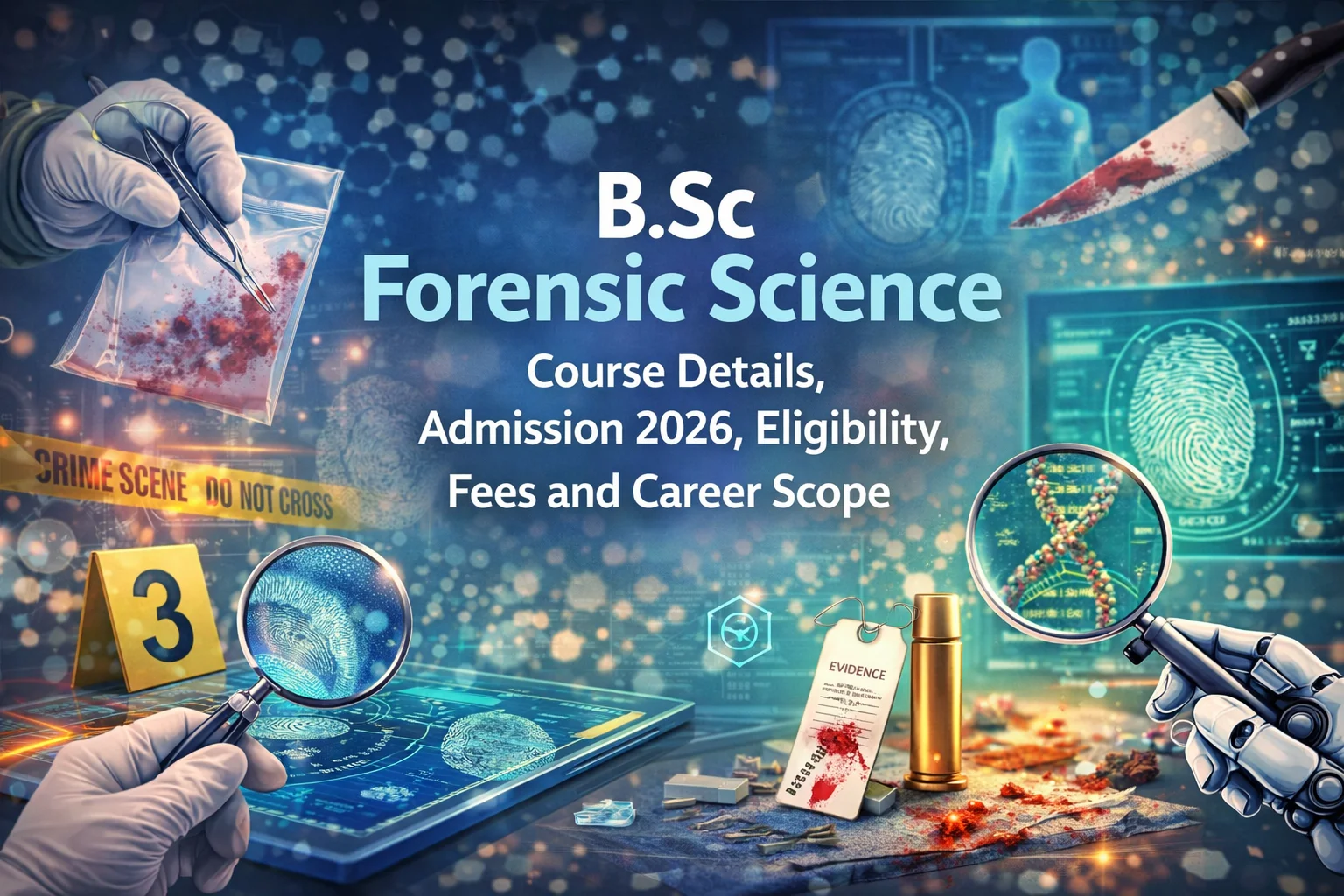
Forensic Science is a fascinating field that combines science and law to solve crimes and deliver justice. It involves the application of scientific techniques to analyze evidence collected from crime scenes, such as fingerprints, blood samples, DNA, and digital data. From criminal investigations to cybercrime analysis, forensic science plays a crucial role in modern law enforcement.
With the increasing use of scientific methods in criminal investigations, the demand for skilled forensic professionals is growing rapidly in India. Government agencies, forensic laboratories, and investigative departments rely heavily on forensic experts to analyze evidence and support legal proceedings.
The B.Sc Forensic Science course is an undergraduate program designed to train students in crime scene investigation, laboratory analysis, and forensic technologies. This guide explains B.Sc Forensic Science course details, admission 2026, eligibility, fees, and career scope to help students understand how to build a career in forensic science.
Table of Contents
B.Sc Forensic Science Full Form
B.Sc Forensic Science stands for Bachelor of Science in Forensic Science. It is a three-year undergraduate program that focuses on applying scientific principles to criminal investigations and legal processes.
Role of Forensic Science Professionals
Forensic science professionals work closely with law enforcement agencies and legal authorities to analyze evidence and solve criminal cases.
Their responsibilities include:
- Collecting and preserving evidence from crime scenes
- Analyzing biological samples such as blood, DNA, and tissues
- Conducting fingerprint and handwriting analysis
- Performing chemical and toxicology tests
- Preparing forensic reports for court proceedings
- Assisting police and investigative agencies
These professionals play a vital role in ensuring accurate and scientific investigation of crimes.
B.Sc Forensic Science Course Structure in India
The B.Sc Forensic Science course provides a strong foundation in scientific principles, criminal law, and forensic analysis techniques.
Course Duration
| Component | Duration |
|---|---|
| Academic Study | 3 Years |
| Total Semesters | 6 Semesters |
Some universities also offer a 4-year Honors or Research program.
The course includes classroom lectures, laboratory training, fieldwork, and sometimes internships in forensic laboratories.
Academic Learning Phases
The B.Sc Forensic Science curriculum can be divided into three academic phases.
Foundation Phase
Duration – First Year
Major Subjects
- Basic Physics, Chemistry, and Biology
- Introduction to Forensic Science
- Criminal Law Basics
- Environmental Science
Key Learning Objectives
The foundation phase introduces students to basic scientific concepts and legal frameworks related to forensic science. Students learn how science is applied in crime investigations.
This phase builds the foundation required for advanced forensic studies.
Forensic Sciences Phase
Duration – Second Year
Major Subjects
- Forensic Biology
- Forensic Chemistry
- Forensic Physics
- Toxicology
- Fingerprint Analysis
Key Learning Objectives
In this phase, students study different branches of forensic science and evidence analysis techniques. They learn how to examine biological, chemical, and physical evidence collected from crime scenes.
Students also develop practical skills for laboratory analysis.
Advanced Forensic and Investigation Phase
Duration – Third Year
Major Subjects
- DNA Profiling
- Cyber Forensics
- Ballistics
- Questioned Documents Analysis
- Forensic Psychology
Key Learning Objectives
The final phase focuses on advanced forensic techniques and criminal investigation methods. Students learn how to analyze complex evidence and apply forensic tools in real-world scenarios.
This phase prepares students for careers in forensic laboratories and law enforcement agencies.
Practical Training and Industrial Exposure
Practical training is a key component of the B.Sc Forensic Science course because forensic science is highly application-based.
Laboratory Training
Students perform experiments related to:
- DNA analysis and profiling
- fingerprint examination
- toxicology testing
- chemical analysis of evidence
Crime Scene Simulation
Some institutions provide mock crime scene training, where students learn how to collect and preserve evidence.
Internship and Field Exposure
Students may get opportunities to intern in:
- forensic science laboratories
- police departments
- investigative agencies
This exposure helps students gain real-world experience in forensic investigations.
B.Sc Forensic Science Admission 2026
Admission to the B.Sc Forensic Science course can be based on entrance exams or merit-based selection.
Common Entrance Exams
Some universities conduct entrance exams, while others offer admission based on 12th-grade marks.
Common exams include:
- CUET UG (Common University Entrance Test)
- State-level entrance exams
- University-specific entrance tests
Many private universities also offer direct admission based on merit.
Step-by-Step Admission Process for B.Sc Forensic Science
Step 1: Check Eligibility
Candidates must have passed or be appearing in 10+2 with Science subjects (PCB or PCM) with at least 50% marks (45% for reserved categories).
Step 2: Entrance Exam Registration
Students must register for entrance exams such as CUET UG or university-level exams if required.
Step 3: Application Process
Fill out the online application form on the university website and upload required documents:
- Class 12 mark sheet
- ID proof
- passport-size photograph
Step 4: Entrance Exam or Merit List
Students either appear for entrance exams or wait for merit list announcements.
Step 5: Counseling and Document Verification
Shortlisted candidates participate in counseling sessions and document verification.
Step 6: Admission Confirmation and Fee Payment
Students must pay the admission fee to confirm their seat and receive an admission letter.
B.Sc Forensic Science Eligibility Criteria 2026
Educational Qualification
Candidates must complete 12th grade with science subjects:
- Physics
- Chemistry
- Biology or Mathematics
Minimum Marks
- 45%–50% aggregate marks in PCB/PCM
Age Criteria
- Minimum age is usually 17 years at the time of admission.
B.Sc Forensic Science Fees Structure
Government Colleges
| Fee Type | Approximate Cost |
|---|---|
| Tuition Fee | ₹20,000 – ₹1,00,000 per year |
Private Colleges
| Fee Type | Approximate Cost |
|---|---|
| Tuition Fee | ₹1,00,000 – ₹3,00,000 per year |
Additional Costs
- Hostel accommodation
- Laboratory fees
- Study materials
Additional expenses may range from ₹30,000–₹1,00,000 per year.
Financial Support Options
Scholarships
Students can apply for scholarships based on:
- academic performance
- financial background
- government schemes
Education Loans
Banks provide education loans covering:
- tuition fees
- hostel expenses
- books and materials
Career Opportunities After B.Sc Forensic Science
The career after B.Sc Forensic Science offers exciting opportunities in criminal investigation, law enforcement, and scientific research.
Top Job Roles After B.Sc Forensic Science
Forensic Scientist
Analyze evidence and assist in solving criminal cases.
Crime Scene Investigator
Collect and preserve evidence from crime scenes.
DNA Analyst
Perform DNA profiling and genetic analysis.
Forensic Toxicologist
Study the effects of drugs and chemicals in the human body.
Digital Forensics Expert
Investigate cybercrimes and analyze digital evidence.
Forensic Document Examiner
Analyze handwriting, signatures, and documents for authenticity.
Top Recruiting Sectors
Government Sector
- Forensic Science Laboratories
- Police Departments
- CBI and Investigation Agencies
Private Sector
- Private forensic labs
- Cyber security firms
- Legal consultancy firms
Healthcare and Research
- hospitals
- research laboratories
Higher Education Options
M.Sc Forensic Science
Advanced specialization in forensic science.
M.Sc Criminology
Focus on criminal behavior and investigation.
Cyber Forensics Courses
Specialization in digital crime investigation.
Law (LLB)
Students can combine forensic science with legal studies.
Salary Expectations
| Experience Level | Average Salary |
|---|---|
| Entry Level | ₹3 LPA – ₹5 LPA |
| Mid Level | ₹6 LPA – ₹8 LPA |
| Experienced Professionals | ₹10 LPA or higher |
Government forensic experts may receive additional benefits and job security.
Essential Skills for Forensic Science Professionals
Technical Skills
- forensic analysis techniques
- DNA profiling
- laboratory testing
- digital forensics
Analytical Skills
- critical thinking
- problem-solving
- attention to detail
Soft Skills
- communication skills
- teamwork
- report writing
Conclusion
The B.Sc Forensic Science course is an excellent option for students interested in science, criminal investigation, and law enforcement. It offers a unique combination of scientific knowledge and investigative skills.
With increasing reliance on forensic evidence in criminal justice systems, the career after B.Sc Forensic Science is growing rapidly. Students passionate about solving crimes and working in investigative fields can consider this course as a rewarding and impactful career path.
Explore all Life Sciences & Research Fields
| Course | Link |
| B.Sc Biotechnology | Click here |
| B.Sc Microbiology | Click here |
| B.Sc Biochemistry | Click here |
| B.Sc Forensic Science | Click here |
| B.Sc Genetics | Click here |
| B.Sc Agriculture | Click here |
Frequently Asked Questions
What is B.Sc Forensic Science?
B.Sc Forensic Science is an undergraduate course that applies scientific principles to investigate crimes and analyze evidence. It teaches students how to examine fingerprints, DNA, blood samples, and other forensic evidence used in legal cases. This course is ideal for students interested in both science and criminal investigation.
What is the duration of the B.Sc Forensic Science course?
The B.Sc Forensic Science course duration is typically 3 years, divided into six semesters. Some universities also offer a 4-year Honors or Research program with additional specialization and research opportunities. The course includes both theoretical and practical training.
What subjects are required for admission to B.Sc Forensic Science?
Students must complete 12th grade with science subjects, including Physics, Chemistry, and Biology (PCB) or Mathematics (PCM). These subjects help build a strong foundation in scientific concepts required for forensic analysis. Some colleges may also require English as a compulsory subject.
What is the eligibility criteria for B.Sc Forensic Science?
The B.Sc Forensic Science eligibility criteria generally require students to pass 10+2 with at least 45% to 50% aggregate marks in science subjects. Some universities may have higher cut-offs or additional entrance exam requirements. Age criteria may also apply in certain institutions.
How can I get admission to B.Sc Forensic Science in 2026?
Students can apply for B.Sc Forensic Science admission 2026 through entrance exams like CUET or through merit-based admission. After qualifying, candidates usually participate in counseling and document verification. The final step is fee payment to confirm admission.
What is the average fee for B.Sc Forensic Science in India?
The B.Sc Forensic Science fees vary depending on the college type. Government colleges may charge around ₹20,000 to ₹1,00,000 per year, while private colleges may charge ₹1,00,000 to ₹3,00,000 annually. Additional costs like hostel and lab fees may also apply.
What career opportunities are available after B.Sc Forensic Science?
There are many career opportunities after B.Sc Forensic Science in law enforcement, forensic labs, and research organizations. Graduates can work as forensic scientists, crime scene investigators, DNA analysts, or forensic experts. Both government and private sector opportunities are available.
What is the starting salary after B.Sc Forensic Science?
The starting salary after B.Sc Forensic Science usually ranges between ₹3 lakh and ₹5 lakh per year depending on the job role and organization. With experience and specialization, professionals can earn higher salaries. Government jobs may offer additional benefits and stability.
Can I work in the government sector after B.Sc Forensic Science?
Yes, graduates can apply for jobs in government organizations such as forensic laboratories, police departments, and investigative agencies. Recruitment may require clearing competitive exams or specific eligibility criteria. Government roles offer job security and growth opportunities.
What higher studies can I pursue after B.Sc Forensic Science?
After completing the course, students can pursue M.Sc Forensic Science, Criminology, or Cyber Forensics for specialization. Some students also choose law (LLB) to combine forensic science with legal expertise. Higher studies improve career prospects and open advanced roles.