

Every year, over 1.5 crore Indian students finish Class 10 and face a decision that shapes the next 40 years. Science, commerce, humanities, or one of the growing hybrid streams. Yet most choose based on peer pressure or a rushed teacher conversation. The result is visible in every Indian college classroom, where students later admit they picked the wrong stream.
Career assessment tests solve exactly this problem. They give students, parents, and counsellors a data-backed picture of natural aptitude, personality, interests, and cognitive strengths before the wrong choice gets locked in. Not every test is equally useful, and Indian students need assessments that map to local career pathways.
This ranked guide covers 8 tests that genuinely help Indian students before Class 12, scored on scientific validity, age fit, and Indian relevance.
Why Career Assessments Matter Before Class 12
Class 11 stream selection is one of the most consequential decisions an Indian student makes. Once locked in, switching streams is expensive and often closes off entire career families.

A good assessment helps in three ways. It moves the conversation from opinion to evidence, so families see actual data instead of defaulting to “beta science le lo”. It opens up options students may not have considered, from behavioural sciences to sports management to hybrid AI-plus-design careers. And it builds student ownership of the decision, which improves motivation.
DMIT can be done from age 5, while structured psychometric tests suit students from Class 8 onwards.
How We Ranked These 8 Tests
Our ranking uses four criteria: scientific validity (peer-reviewed research base), age suitability, comprehensiveness (aptitude, personality, and interests versus just one), and Indian relevance (how well results map to careers available in India).
The 8 Career Assessment Tests, Ranked

1. DMIT (Dermatoglyphics Multiple Intelligence Test)
DMIT takes rank 1 because it is the only test here that works from age 5, needs no reading skills, and combines cognitive style analysis with Gardner’s Multiple Intelligences in one sitting.
DMIT analyses fingerprint patterns to identify a child’s dominant learning style, brain lobe dominance, and innate intelligence distribution across the eight intelligences. The science is rooted in embryology, since fingerprint ridges and the neocortex develop simultaneously between the 13th and 24th week of pregnancy.
Parents often ask whether DMIT is genuine or a scam. A well-conducted DMIT with validated software provides a useful data point, especially alongside a psychometric assessment. MindGenics’ DMIT software is used by counsellors across India.
Best for: All students from age 5 onwards, especially before Class 8.
2. Psychometric Career Assessment
Psychometric tests take the second spot as the gold standard in structured career assessment. Backed by decades of research, they measure aptitude, personality, interests, and career preferences through validated questionnaires.
A comprehensive psychometric assessment delivers a career readiness score, personality profile, aptitude across verbal, numerical, spatial, and abstract reasoning, and a mapping of preferred career families. Results are age-normed against peers of the same grade, which makes them far more reliable than a generic online quiz.
MindGenics offers India’s most trusted psychometric software for counsellors and schools, used to deliver detailed 40 to 60-page reports. It works best from Class 8 upwards, since students need to read and respond thoughtfully.
Best for: Class 8 to 12, particularly before Class 11 stream selection and Class 12 college choice.
3. Multiple Intelligences Assessment
Based on Harvard psychologist Howard Gardner’s theory, this test identifies which of the eight intelligences a student is naturally strong in. Unlike IQ testing, it recognises that a student weak at mathematics may be exceptional at spatial or interpersonal intelligence.
For parents raised on the science-commerce-arts trilogy, this can be eye-opening. A child high on bodily-kinesthetic intelligence may be better suited to sports science, physiotherapy, or performing arts than a forced science stream. Our multiple intelligences theory and career paths guide breaks down each type with matching Indian career options.
Best for: All ages, especially Classes 6 to 10 for stream selection.
4. Aptitude Test
Aptitude tests measure a student’s natural ability in specific areas: verbal, numerical, abstract, spatial, and mechanical reasoning. Unlike interest tests, they measure what a student can do, not what they want to do.
Aptitude scores matter most before entrance-heavy choices. Engineering, architecture, chartered accountancy, and medicine each demand strong performance in specific aptitude clusters. A student in the bottom 30 percent on numerical and spatial ability will struggle through JEE regardless of the hours put in.
Best for: Class 9 to 12, especially when entrance exam preparation is planned.
5. Holland Code (RIASEC) Interest Inventory
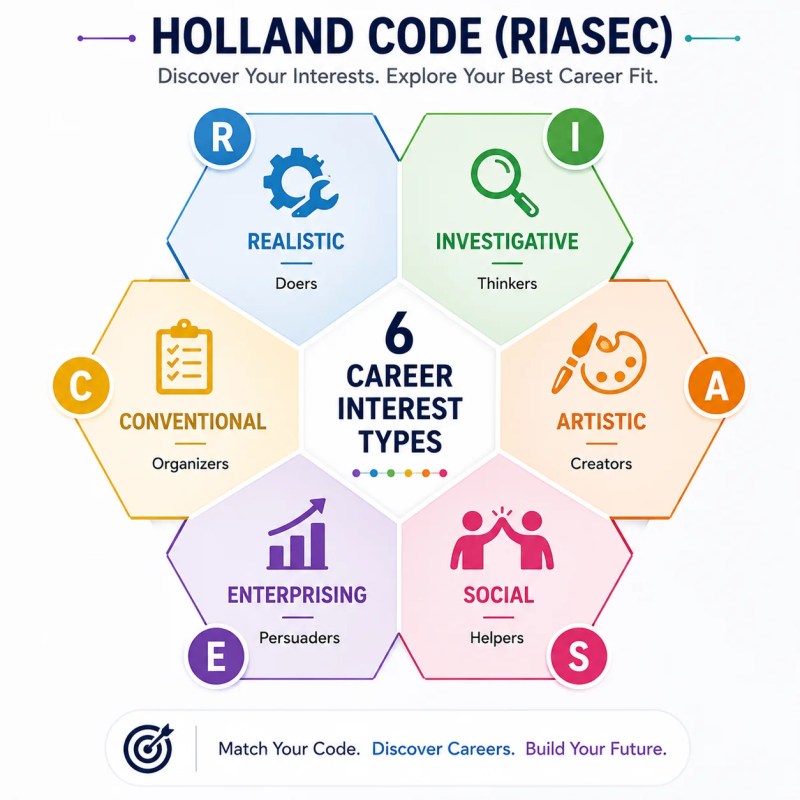
Developed by John Holland, RIASEC classifies students into six interest types: Realistic, Investigative, Artistic, Social, Enterprising, and Conventional. Every career has a three-letter Holland Code, and matching a student’s code to a career with a similar code improves job satisfaction.
RIASEC is short, well-validated, and widely used in Indian government career counselling programmes. It measures interests only, so pairing it with an aptitude test is essential.
Best for: Class 9 onwards, for students exploring which broad career families excite them.
6. Big Five Personality Test (OCEAN)
The Big Five is the most scientifically respected personality framework in modern psychology, measuring Openness, Conscientiousness, Extraversion, Agreeableness, and Neuroticism. Each trait has research links to career outcomes and is more predictive of job performance than older frameworks.
A student high on Conscientiousness may thrive in structured careers like accountancy or medicine, while one high on Openness may fit entrepreneurial or creative fields.
Best for: Class 11 and 12 students planning specific career tracks.
7. MBTI (Myers-Briggs Type Indicator)

MBTI classifies people into 16 personality types across four dimensions: Introversion or Extraversion, Sensing or Intuition, Thinking or Feeling, and Judging or Perceiving. It is popular globally and widely used in Indian corporate settings and college placement cells.
Psychologists rank MBTI lower in reliability than the Big Five, because most people fall in the middle of each dimension. It remains useful as a discussion starter for older students.
Best for: Class 11 and 12, best used as a discussion aid rather than a final verdict.
8. Career Interest Inventory
A Career Interest Inventory maps a student’s activity preferences to career families. Tests such as the Strong Interest Inventory or the Kuder Preference Record fall here, and they are useful because they are quick and easy to interpret.
While less sophisticated than DMIT or psychometric, an interest inventory is a low-cost first step for younger students, especially when parents want a starting point for conversations at home.
Best for: Class 8 and 9 students beginning their career exploration.
Quick Comparison of the 8 Career Assessment Tests

| Rank | Test | Ideal Age | What It Measures | Time |
| 1 | DMIT | 5 years and up | Innate intelligence, learning style, and brain dominance | 15 to 20 min |
| 2 | Psychometric Assessment | Class 8 and up | Aptitude, personality, interests, career fit | 60 to 90 min |
| 3 | Multiple Intelligences | All ages | Eight intelligence types | 30 to 45 min |
| 4 | Aptitude Test | Class 9 and up | Verbal, numerical, spatial, and abstract ability | 45 to 60 min |
| 5 | Holland Code (RIASEC) | Class 9 and up | Six career interest types | 15 to 20 min |
| 6 | Big Five (OCEAN) | Class 11 and up | Five personality traits | 20 to 30 min |
| 7 | MBTI | Class 11 and up | 16 personality types | 30 min |
| 8 | Career Interest Inventory | Class 8 and up | Interest patterns | 20 to 30 min |
How to Combine These Tests for the Best Results
No single test can answer “what career should I choose” alone. The most reliable approach combines assessments across three dimensions: innate strengths, acquired abilities, and personal interests.
A practical Indian sequence: before Class 8, use DMIT to identify natural learning style. In Class 9 or 10, add a psychometric assessment. In Classes 11 and 12, revisit with a Big Five or Holland Code test to refine direction before college. Our DMIT vs IQ vs aptitude vs psychometric comparison breaks down the strengths of each.
Why MindGenics is India’s Trusted Career Assessment Partner
MindGenics has spent years building India’s most comprehensive DMIT and psychometric software platform, used by career counsellors, schools, and coaching institutes across the country. Our software delivers scientifically validated reports, parent summaries, and detailed counsellor guides for both DMIT Brain Mapping and Psychometric Career Counselling assessments.
Counsellors choose MindGenics because our reports are backed by validated research, our platform supports in-person and online assessments, and our team provides ongoing training. Schools use our psychometric assessment software to run career guidance programmes across Classes 8 to 12, and we offer franchise opportunities for education entrepreneurs. To request a sample report, write to sales@mindgenics.in.
Conclusion

The right career for your child is not a mystery to be guessed at. It is a pattern to be discovered through the right mix of assessments at the right ages. Starting early with DMIT, building on it with a validated psychometric assessment, and adding interest and personality tests before college creates a framework any Class 12 student would benefit from.
If you are a parent, school leader, or counsellor looking to bring science-backed career assessment to your students, MindGenics is here to help. Visit to explore our DMIT and psychometric software built for the Indian education market.
Frequently Asked Questions
At what age should my child first take a career assessment test?
Children can take DMIT as early as age 5 since it needs no reading skills. Structured psychometric assessments work best from Class 8 onwards, when students can meaningfully respond to statements about themselves.
Is DMIT scientifically valid, or is it a pseudoscience?
DMIT is based on established dermatoglyphics research and Gardner’s Multiple Intelligences theory. When conducted using validated software and a trained counsellor, DMIT delivers useful insights, especially when combined with a psychometric assessment.
How is a psychometric test different from a DMIT test?
DMIT analyses fingerprint patterns to reveal innate intelligences, while psychometric tests use structured questionnaires to measure aptitude, personality, and interests. DMIT reflects natural potential, whereas psychometric shows current abilities and career preferences.
Should my child take just one test or multiple assessments?
Combining multiple tests gives the most reliable picture. A strong sequence is DMIT for innate strengths, psychometric for aptitude and personality, and a Holland Code test for interest refinement before college applications.
How long does a career assessment test take to complete?
Most assessments take between 15 and 90 minutes. DMIT typically needs 15 to 20 minutes for fingerprint scanning, while a full psychometric battery may run 60 to 90 minutes.
Can these career tests be taken online in India?
Yes, DMIT and psychometric tests can be taken online through certified counsellors. MindGenics offers cloud-based software that allows counsellors to conduct assessments remotely with the same accuracy as in-person sessions.
Do career assessment tests really predict future job success?
Assessments are guidance tools, not fortune tellers. They significantly improve the odds of choosing a well-fitting career by matching a student’s aptitude, personality, and interests to suitable career families and colleges.
Is Class 10 too late to take a career assessment test?
Class 10 is one of the most important stages for an assessment because stream selection follows. Ideally, students should also take a refresher test in Class 12 before college applications are finalised.
What is the cost of a career assessment test in India?
Costs range from ₹1,500 to ₹15,000 depending on the depth of the test and the counsellor’s expertise. Comprehensive DMIT plus psychometric packages typically fall in the ₹5,000 to ₹10,000 range.
Can schools offer these career assessment tests to all students?
Yes, many CBSE and ICSE schools now run structured career assessment programmes for Classes 8 to 12 using platforms like MindGenics. School-wide implementation is more affordable and ensures consistent guidance for every child.

